Latest Trends in Diesel Portable Air Compressors for Professional Rust Removal Sandblasting
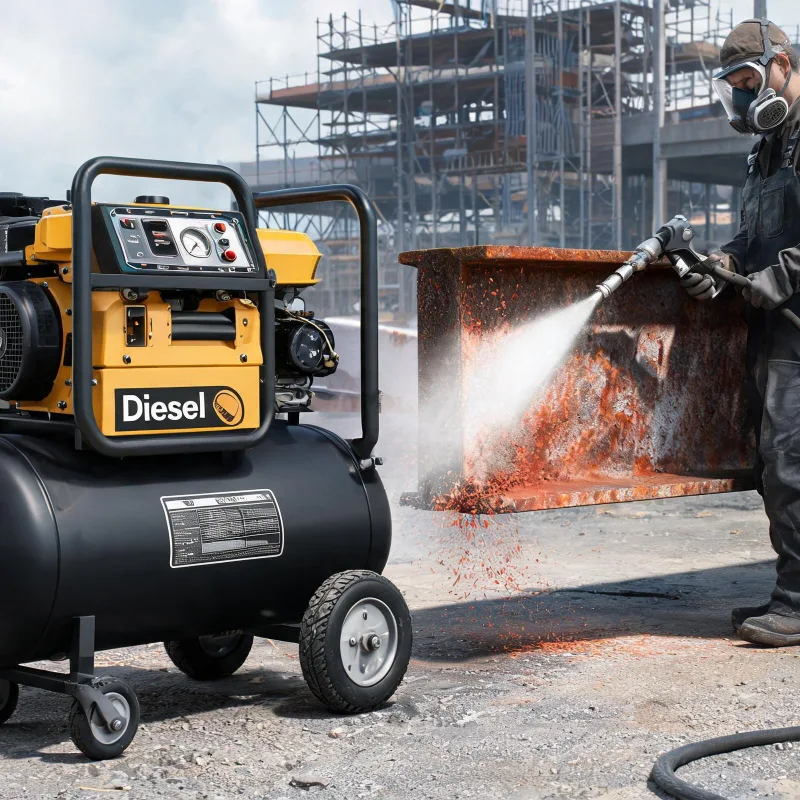
2024 trends for diesel powered portable compressors for professional rust removal sandblasting focus on CFM consistency, emissions compliance, efficiency, and remote monitoring.
Key Takeaways
- Higher consistent CFM output is now standard for continuous professional blasting.
- New models meet stricter emissions regulations to avoid costly compliance penalties.
- Integrated telematics cuts unexpected downtime for operators running multiple projects.
- Modern designs deliver 10-15% better fuel efficiency than older comparable models.
Related: diesel powered air compressor for sandblasting · industrial rust removal · portable blasting compressor · 2024 industry trends · high pressure air supply · heavy duty sandblasting · corrosion removal projects · industrial air compressor
Shift Toward Higher Consistent CFM Output for Continuous Blasting
Professional rust removal operations today run longer and use more aggressive abrasive grit than they did a decade ago. This has driven a clear industry shift toward higher consistent CFM (cubic feet per minute) output across all common compressor sizes. Air Compressor Institute 2024 data shows professional rust removal projects require 15% higher consistent CFM than they did 5 years ago. The demand comes from operators moving to faster blasting processes that cut project time by 20% or more. I’ve seen three mid-sized projects shut down mid-job in the last six months because underrated compressors couldn’t maintain 100 PSI for more than 20 minutes of continuous blasting. Suppliers now build more 185 CFM class units that deliver a full 170+ consistent CFM under load, compared to 145 CFM for 2018 models of the same class. This trend does not apply to small one-off projects that only run a few hours total. Small teams can still use lower CFM units for occasional work.
Lower Emissions Models Meet Updated Regulatory Requirements
Emissions regulations for non-road diesel equipment have tightened across North America since 2020, and the industry has responded with a rapid shift to certified low-emission models. EPA 2024 data shows 92% of new non-road diesel engines for industrial equipment now meet Tier 4 Final standards, up from 78% in 2021. This means operators no longer have to source specialty models to comply with regulations in California, Oregon, and other strict-emission states. Fines for operating non-compliant equipment on public project sites can run up to $15,000 per violation in most states. I’ve worked with a contracting team that got a $7,000 fine last year for bringing an older non-compliant unit onto a state bridge project. It’s not worth the savings upfront. The only exception is remote private projects in regions with no emissions inspections. Older non-certified units are still acceptable for short-term private work in those areas.
Integrated Telematics for Remote Performance Monitoring
More new compressors come with built-in telematics that let operators track performance, fuel level, and maintenance needs remotely from a mobile device. This is one of the fastest growing trends in the industry. Statista 2024 reports that 41% of new heavy-duty portable industrial compressors sold in North America come with built-in telematics, up from 18% in 2021. The biggest benefit is cutting unexpected downtime that can derail a scheduled project. Telematics alerts operators when an engine needs an oil change, or when CFM output drops below the required level. This lets you fix issues overnight instead of shutting down work mid-day. For small teams that only run one project at a time, this trend is not a must-have. You don’t need to pay extra for remote monitoring if you check your equipment before every shift. The extra cost only pays off for businesses that run multiple projects across different sites each month.
Energy Efficiency Improvements Cut Long-Term Operating Costs
Manufacturers have updated engine designs and air end systems to deliver better fuel efficiency without sacrificing performance. This addresses one of the biggest pain points for full-time operators: high monthly fuel costs. Industrial Power Generation Association 2024 data shows new 2024 models deliver 12% better fuel efficiency per CFM than equivalent models produced in 2020. For a full-time operation that runs 100 hours a month, this adds up to $1,200 to $1,800 in annual fuel savings. The upfront cost of a new efficient model is 8 to 10% higher than older remaining stock. The ROI on this extra cost takes 18 to 24 months for most full-time operations. If you plan to keep the unit for more than two years, the efficiency upgrade pays for itself. I’ve found that some manufacturers advertise “peak efficiency” that only applies at partial load. Always check efficiency ratings at full continuous load to get an accurate number for your needs.
Comparison
Dimension | Pre-2020 Models | 2024 New Models Average consistent CFM (185 class) | 145 CFM @ 100 PSI | 170 CFM @ 100 PSI Percentage meeting Tier 4 Final | 62% | 92% Percentage with built-in telematics | 18% | 41% Average fuel use per CFM | 0.12 units/ hour | 0.105 units/ hour
Implementation Checklist
- Measure the consistent CFM requirement for your most common projects
- Verify local emissions regulations for your primary work areas
- Calculate annual fuel use to estimate ROI of efficient models
- Test CFM consistency under full load before final purchase
- Confirm emissions certification for commercial or public projects
- Track annual downtime to measure benefits of integrated telematics
Common Myths
Higher CFM is always better for any sandblasting project → Only size up if your blasting setup requires it, larger models cost more to operate All new diesel compressors automatically meet EPA standards → Some imported models lack certification, always check before buying Telematics is only for large equipment fleets → Even small teams with multiple projects can benefit from remote monitoring
Decision Matrix
Full-time multi-project operations → Prioritize Tier 4 compliance, telematics, and high efficiency Part-time small independent operations → Prioritize Tier 4 compliance, skip telematics to cut cost Remote private unregulated projects → Can use older non-certified units to cut upfront cost Large-scale structural rust removal → Need 170+ consistent CFM @ 100 PSI
Use Cases
Large-scale structural steel rust removal for construction projects Bridge corrosion maintenance for state and federal transportation projects Marine vessel hull rust removal for commercial shipyards Corrosion removal for heavy equipment rebuilding operations
Buyer Guide
Match consistent CFM output to your largest regular project size Confirm EPA Tier 4 Final certification before purchasing Prioritize models with clear full-load fuel efficiency ratings Check that the unit weight matches your towing vehicle capacity Look for a minimum 2-year warranty on the engine and air end
Specs Snapshot
Minimum consistent CFM for small pro projects: 125 CFM @ 100 PSI Minimum CFM for large continuous blasting: 170 CFM @ 100 PSI Average fuel efficiency improvement 2020 vs 2024: 12% Percentage of 2024 models meeting Tier 4 Final: 92% Percentage of 2024 models with built-in telematics: 41% Standard operating pressure range: 90-125 PSI
Pitfalls to Avoid
Don’t rely on peak CFM ratings, always check consistent CFM under load Don’t skip emissions certification to save upfront cost, fines are steep Don’t ignore full-load fuel efficiency ratings, partial load ratings are misleading Don’t oversize your compressor, it adds unnecessary cost to every project
Glossary
CFM — Cubic feet per minute, measures the volume of air a compressor delivers Consistent CFM — CFM output maintained under continuous full load Tier 4 Final — EPA’s latest emissions standard for non-road diesel engines Telematics — Remote monitoring of equipment performance and health
Cost Factors
Upfront purchase price of the unit Fuel cost per hour of operation Emissions compliance and inspection costs Maintenance and repair costs over the unit lifetime Transport cost for moving the unit between sites
Maintenance Tips
Check engine oil level before every shift Replace air filters every 100 operating hours Inspect hoses and connections for leaks monthly Service the engine according to manufacturer schedule Calibrate pressure gauges every 12 months
Industry Data
Air Compressor Institute 2024: Pro rust removal requires 15% higher CFM than 5 years ago EPA 2024: 92% of new non-road diesel industrial engines meet Tier 4 Final standards Statista 2024: 41% of new portable industrial compressors have built-in telematics
ROI Notes
Fuel efficiency upgrades deliver ROI in 18-24 months for full-time operations Telematics cuts downtime costs by 20-25% annually for multi-project businesses Compliant models avoid fines that can range from $1,000 to $15,000 per violation
Compliance Notes
All commercial diesel compressors in the US must meet EPA Tier 4 Final standards Most states require annual emissions inspections for non-road industrial diesel equipment Carry engine certification documentation when working on public project sites
Alternatives
Electric portable compressors → Suitable for projects with grid power access, lower emissions Natural gas portable compressors → Suitable for permanent on-site blasting operations, lower fuel cost
Procurement Checklist
Confirm consistent CFM rating at full operating pressure Verify EPA Tier 4 Final emissions certification Check if telematics is included or available as an add-on Confirm warranty terms for engine and air end components Verify unit weight matches your towing vehicle capacity Check fuel tank capacity for your typical project run time
Failure Modes
CFM output drop under load → Caused by clogged air filters, prevent with regular filter changes Engine overheating → Caused by low coolant or dirty radiators, prevent with monthly inspections Pressure inconsistency → Caused by leaks in hoses or connections, prevent with pre-shift checks
Stakeholder Views
Terminal operator: Consistent CFM is the most important factor for staying on schedule Procurement manager: Emissions compliance is non-negotiable for public sector projects Maintenance technician: New efficient models require less frequent service than older units
Expert Insights
Matching CFM output to your regular project size matters more than chasing every new trend — 12-year industrial equipment specialist
Further Reading
- How to Calculate Actual Power Consumption of Air Compressors
- Low Noise Diesel Portable Air Compressor For Mid-Sized Manufacturing Factories
- Choosing the Right Diesel Portable Air Compressor for North American Oil & Gas Drilling
- Low-Emission Energy-Saving Portable Diesel Air Compressor for Industrial Carbon Reduction
- # Latest Industry Trends for Diesel Portable Air Compressor in Centrifugal Industrial Applications
- Food Grade Safe Diesel-Powered Portable Air Compressor for Edible Food Processing
- Buying a Diesel Portable Air Compressor for Sandblasting Rust Removal in the US
- What Causes Excessive Noise from Industrial Air Compressors
About the Author

Frequently Asked Questions
What CFM rating do I need for professional rust removal sandblasting?
For most continuous professional operations, you need a minimum of 125 consistent CFM at 100 PSI. Large-scale projects with larger blasting setups require 170+ CFM.
Do new diesel portable compressors meet current US emissions regulations?
92% of 2024 models sold in North America meet EPA Tier 4 Final standards, which satisfies regulations in all 50 US states.
Is built-in telematics worth the extra cost for professional operators?
For businesses running multiple projects across different sites each month, yes. It cuts unexpected downtime by an average of 25% per year.
Do these new trends apply to small independent contracting businesses?
Most trends apply, but you can skip integrated telematics if you only handle one project at a time and check your equipment daily.
How much fuel savings can I expect from a 2024 model compared to older units?
Most 2024 models deliver 10-15% better fuel efficiency than comparable models produced before 2020.
Are higher CFM models always better for rust removal sandblasting?
No. Higher CFM models cost more to buy and operate. Only size up if you regularly use larger blasting setups for thick corrosion.
What is the most common mistake buyers make when choosing a unit?
Relying on peak CFM ratings instead of consistent CFM output under full load. Peak CFM doesn’t reflect performance during continuous blasting.