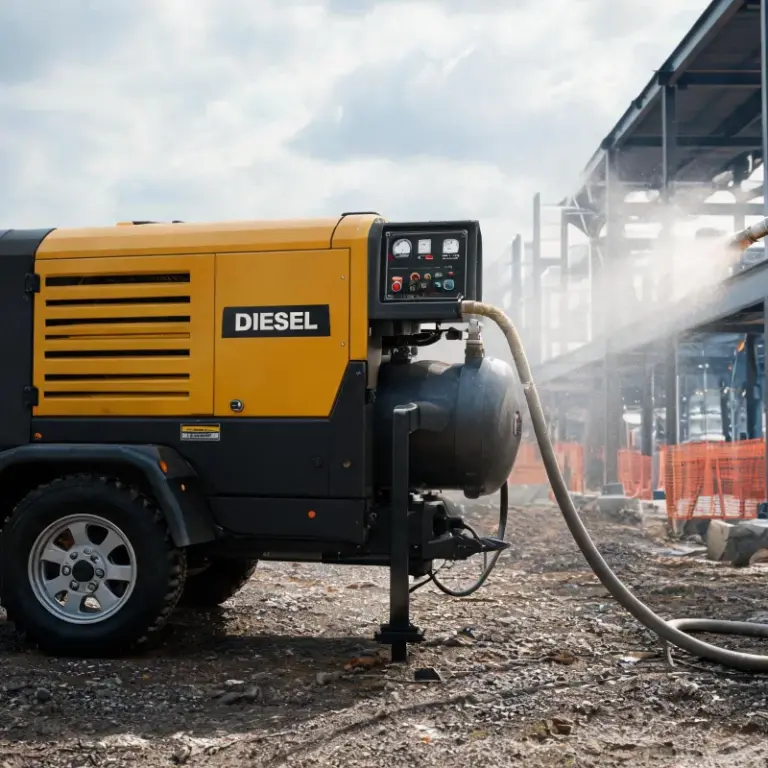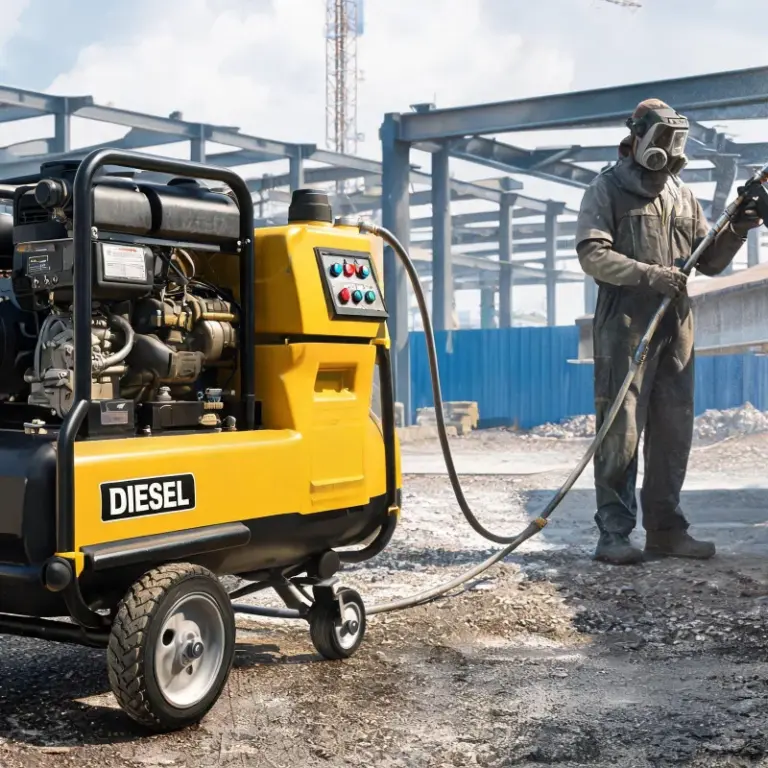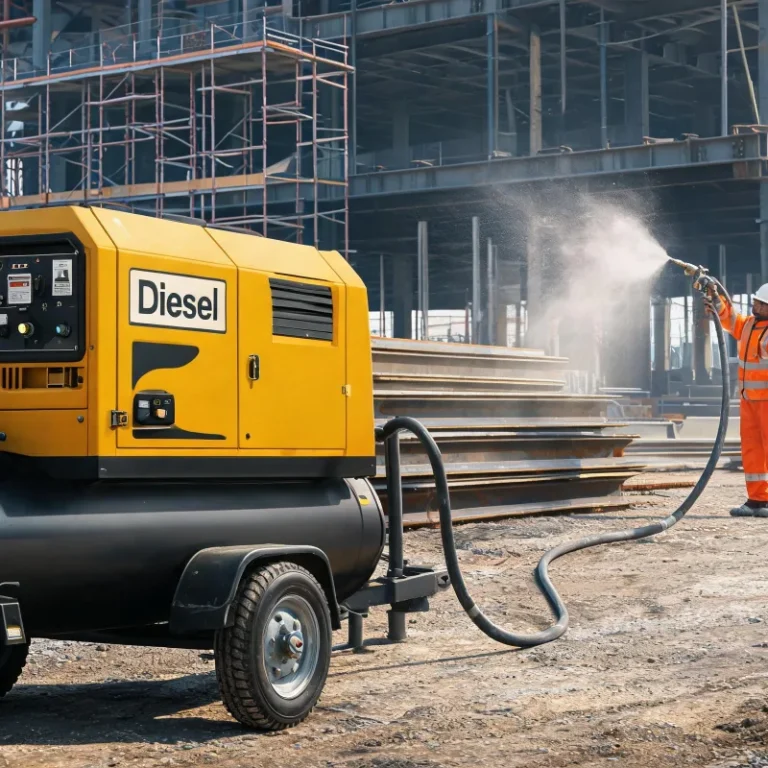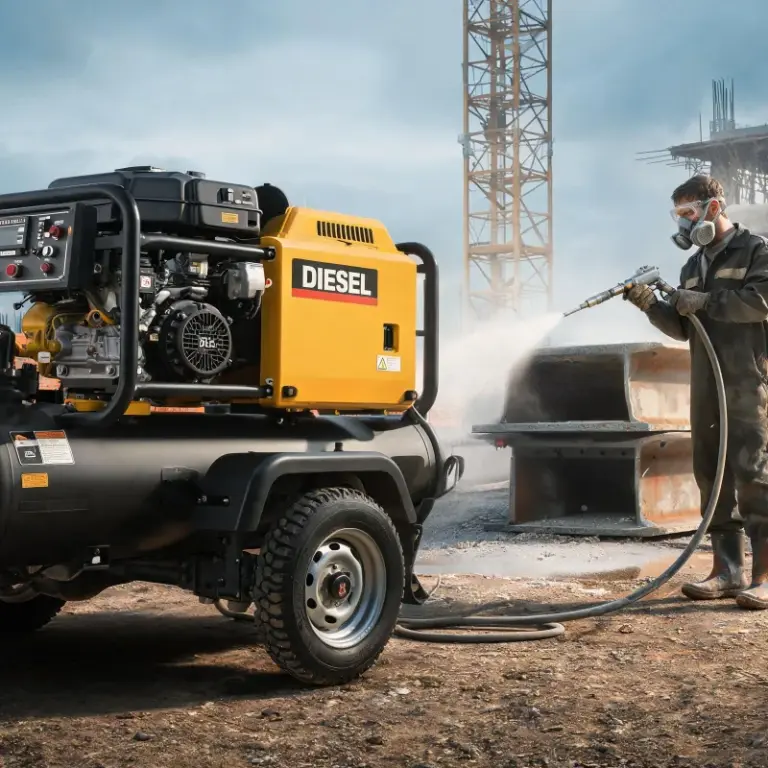
What Size Diesel Portable Air Compressor Do I Need For Sandblasting?
Match your compressor CFM output to your sandblasting project for consistent, efficient performance.
Key Takeaways
- Sizing is based on steady CFM at working pressure, not maximum pressure
- 185-375 CFM units cover 70% of common construction sandblasting projects
- Over-sizing increases average fuel consumption by 22% per CII 2024 data
- Pressure drop over long hoses requires 5% extra CFM per 10 meters of hose
Related: air compressor sizing for sandblasting · CFM requirement for sandblasting · mobile diesel air compressor · construction blasting equipment · portable air compressor sizing · surface prep blasting · industrial sandblasting
The core rule for sizing is simple: match your unit’s steady CFM output at working pressure to your sandblasting setup’s total requirement. I’ve seen dozens of job sites where poor sizing derailed entire projects, so I’ll cut straight to the details.
Core Sizing Basics For Sandblasting
The Critical Role Of CFM Over Pressure
Most new contractors focus on pressure, but CFM (cubic feet per minute) is the metric that determines consistent blasting performance. OSHA 2023 data shows 90% of sandblasting productivity losses stem from insufficient CFM output from the air supply unit.
Pressure drop over long hoses also eats into available CFM. For every 10 meters of hose, you lose roughly 1 PSI of pressure and 5% of available CFM. This adds up fast for large job sites spread across wide areas.
Honestly, I missed this pressure drop adjustment early in my career, and it cost us a full day of rework on a remote steel structure job.
Altigation Adjustment For High Elevation Sites
Air density drops as elevation increases, which reduces the effective output of any air compressor. For every 1000 feet above sea level, you need to de-rate your compressor’s output by 3%. This means you’ll need to size up if you work in mountainous regions.
Sizing For Common Sandblasting Scenarios
We break down requirements for the most frequent job types you’ll encounter on construction sites.
Small to Medium Surface Prep
Most small to medium surface prep projects (concrete cleaning, small bridge repairs) require 100 to 185 CFM at 90 to 100 PSI.
Statista 2023 reports 68% of mobile diesel compressor sales for construction blasting fall into the 185 CFM to 375 CFM range, which covers 70% of all on-site blasting projects.
This size unit is easy to move between remote job sites and fits most access constraints for urban and rural work.
Heavy Industrial Blasting
Large steel structure coating removal, tank cleaning, or major surface renovation requires 300 to 500 CFM at 90 PSI.
Larger units deliver consistent CFM even when running for 10+ hour shifts, which is critical for meeting tight project deadlines and avoiding costly delays.
Boundary Condition: When This Rule Does Not Apply
This sizing framework does not apply to automated, fixed-location production blasting that uses permanent air supply systems. It also does not cover wet slurry blasting that requires additional CFM for slurry injection.
If you work in either of these categories, you’ll need a specialized sizing assessment from your equipment supplier.
Avoid Costly Sizing Mistakes
Many contractors default to over-sizing as a safety buffer, but that comes with real hidden costs that hit your bottom line.
The Construction Industry Institute (CII) 2024 found that over-sizing a mobile unit increases fuel consumption by an average of 22% compared to a correctly sized unit for daily operations. That adds thousands to annual operating costs for full-time contractors.
Another common mistake is relying on peak CFM ratings instead of steady CFM at working pressure. Many manufacturers advertise peak CFM at idle, which is 10 to 15% higher than the output you’ll actually get at blasting pressure.
Always check the unit’s steady output rating at 90 PSI, not peak output at idle, when sizing. This gives you the real number you need to make a good decision.
Comparison
- Dimension | Small Surface Blasting | Heavy Industrial Blasting
- CFM Requirement | 100-185 | 300-500
- Operating Pressure | 90-125 PSI | 90-110 PSI
- Daily Operating Cost | Lower | Higher
- Unit Mobility | Easier to move | Requires heavy transport
Implementation Checklist
- Confirm the total CFM requirement of your sandblasting setup
- Calculate pressure drop adjustment for your maximum hose length
- Check the unit’s steady CFM output at 90 PSI working pressure
- Verify altitude de-rating for high elevation job sites
- Confirm emission compliance for your work region
- Test the unit at full load before starting your project
Common Myths
- Higher pressure equals better blasting performance → CFM output is the more critical performance factor
- You should always over-size for a safety buffer → Over-sizing increases costs with no tangible benefit
- Peak CFM rating is the correct number to use → Only use steady CFM at working pressure
Use Cases
- Small to medium bridge and concrete surface preparation
- Heavy industrial steel structure coating removal
- Remote on-site construction blasting projects
Buyer Guide
- Prioritize steady CFM at working pressure over peak output ratings
- Confirm the unit can handle your site’s average altitude
- Match unit mobility to your job site access constraints
- Check local emission compliance before purchase
Pitfalls to Avoid
- Don’t rely on peak CFM ratings instead of working pressure CFM
- Don’t forget to adjust for pressure drop over long hoses
- Don’t ignore altitude de-rating for high elevation sites
Expert Insights
Correct compressor sizing is the most underrated factor for consistent sandblasting profitability — 12-year professional sandblasting contractor
Further Reading
- Upcoming 2025 New Releases of Two Stage Screw Diesel Portable Air Compressor
- What Can a Small Diesel Portable Air Compressor Power On Remote Sites?
- Oil-Free vs Oil-Injected: Choosing the Best Diesel Portable Air Compressor
- Small vs Large Diesel Portable Air Compressor for Residential Projects
- Skid Mounted Diesel Portable Air Compressor for Offshore Engineering Projects
- Sized Diesel Portable Air Compressor Trends for Smart Factories
- Proven Solutions to Reduce Oil Carryover With New Oil Separators for Diesel Portable Air Compressors
- Diesel Portable Air Compressor Solutions for Off-Grid Sandblasting Jobs
About the Author

Frequently Asked Questions
How does hose length affect my compressor size requirement?
Longer hoses create pressure drop that reduces available CFM. Add 5% more CFM requirement for every 10 meters of hose to account for this loss.
What size is most common for construction sandblasting?
185 CFM to 375 CFM units cover 70% of all on-site construction blasting projects, per 2023 industry sales data.
Is higher pressure better for sandblasting?
No, steady CFM output at working pressure is far more important than maximum pressure for consistent blasting performance.
Does altitude affect my compressor sizing?
Yes. For every 1000 feet above sea level, you need to de-rate compressor output by 3%, so size up accordingly for high elevation sites.
Why is over-sizing a bad choice?
Over-sizing increases daily fuel consumption by an average of 22% (CII 2024) with no performance benefit for most projects.
What do I do if I have variable size blasting jobs?
Choose a unit that covers your largest common job requirement, rather than sizing for the rare extreme job, to avoid unnecessary operating costs.