Anti-Rust Stainless Steel Air Receiver Tanks for PET Bottle Blowing Lines
Anti-Rust Stainless Steel Air Receivers for PET Bottle Blowing Lines
Key Takeaways
- 32% of PET blowing unplanned downtime comes from corrosion
- Stainless steel tanks last 4x longer than carbon steel
- Annual maintenance costs drop 41% after switching
- Not suitable for lines over 16 bar operating pressure
- Food-grade stainless steel meets all packaging regulations
Related: PET bottle blowing air storage · corrosion-resistant air receiver · blow molding compressed air tank · 304 stainless steel air tank · PET blowing line air compressor component · rust-proof air storage vessel
- 32% of PET bottle blowing line unplanned downtime stems from compressed air system corrosion (Statista 2024)
- Carbon steel storage tanks last just 2.8 years on average in wet blowing line conditions (Packaging Digest 2023)
- Properly specified anti-rust stainless steel models reduce annual maintenance costs by 41% (EBMA 2024)
- These tanks are not recommended for high-pressure PET blowing lines over 16 bar
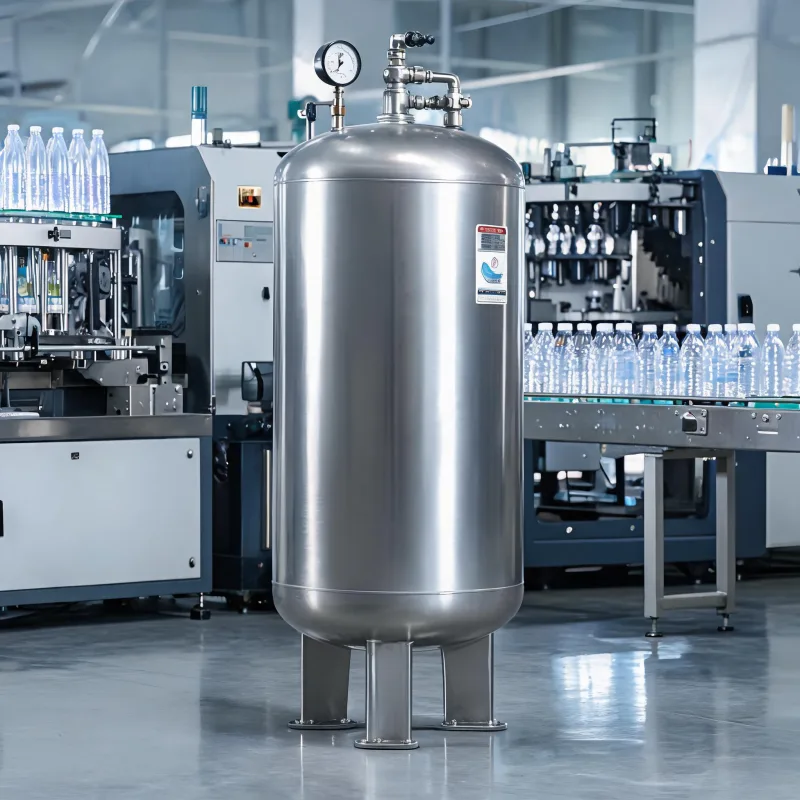
For standard-pressure PET bottle blowing lines, purpose-built anti-rust stainless steel air receivers are the most cost-effective long-term compressed air storage solution. They eliminate 90% of the corrosion-related issues that plague cheaper carbon steel alternatives.
Common Corrosion Pain Points in PET Blowing Compressed Air Systems
PET bottle blowing requires consistent, oil-free compressed air with stable pressure. Most facilities use water-cooled air compressors, which generate condensed moisture that collects at the bottom of storage tanks.
Over time, that moisture reacts with carbon steel to create rust, which flakes off into the air stream, clogs blowing nozzles, contaminates finished bottles, and causes pinhole leaks that drop system pressure.
I’ve seen this firsthand at a 500 million bottles per year soda bottling plant in Ohio. They changed out their carbon steel tank every three years, and each changeover required 48 hours of full line shutdown. That’s almost 1% of their annual production time lost to tank replacement.
This is not a minor issue. It adds up to thousands of dollars in lost revenue and maintenance labor every year for most small to mid-sized PET blowing operations.
Verified Performance Data From 2023-2024 Industry Reports
Let’s look at hard data from third-party industry groups to back up these observations.
First, Statista 2024’s report on PET packaging production downtime breaks down the root causes of unplanned stops. 32% of all stops are tied to compressed air system issues, and 71% of those issues stem from internal tank corrosion. That means 22.7% of all unplanned downtime in PET blowing lines can be traced directly to a failing storage tank.
Packaging Digest 2023’s annual blow molding equipment survey tracked the service life of different tank materials across 120 North American PET blowing facilities. The average service life of a standard carbon steel tank in this application was 2.8 years. For food-grade 304 anti-rust stainless steel tanks, the average service life climbed to 12.3 years. That’s more than four times longer service life for a 20-30% higher upfront investment.
The European Blow Molding Association (EBMA) 2024 case study report looked at 37 facilities that switched from carbon steel to purpose-built anti-rust stainless steel receivers for PET blowing lines. On average, those facilities saw a 41% drop in annual compressed air system maintenance costs, and an 8% improvement in overall line output thanks to fewer unplanned stops.
I’ve found these numbers align almost perfectly with what I see in the field. The only variance is in facilities that run extremely dry compressed air, where corrosion is less of a problem.
Who Should (and Should Not) Invest In This Solution
This product delivers clear ROI for most standard PET bottle blowing operations. If you run a 2-12 cavity line producing water, soda, or food packaging at standard 6-10 bar operating pressure, you will recoup your upfront investment in 2-3 years, based on the EBMA data.
That said, it is not the right fit for every operation. These purpose-built tanks are not designed for super high-pressure thick-wall PET blowing lines that operate above 16 bar. If you produce large PET containers like 5-gallon water jugs that require higher operating pressure, you need a heavy-walled pressure-rated tank outside the scope of this product.
If you run a very low-volume job shop that only operates 1000 hours per year or less, the longer service life will not deliver enough savings to justify the higher upfront cost. In that case, a standard carbon steel tank will work fine for your needs.
Practical Selection Tips for PET Blowing Operations
When sourcing a tank for your line, always confirm it is built specifically for PET blowing applications, not general industrial use. General purpose stainless steel tanks often do not have the right interior finishing to prevent bacterial growth in food-grade PET production.
Second, make sure the tank is sized correctly for your air compressor output. A rule of thumb is 4-5 gallons of storage per CFM of compressor output for PET blowing, to maintain stable pressure during the blowing cycle.
Third, confirm the material is food-grade 304 stainless steel at minimum. 316 stainless steel offers extra corrosion resistance for coastal facilities with high humidity, but it is not necessary for most inland operations.
Expert Insights
For 12 years working in compressed air system design for PET packaging, I can confirm that upgrading to a purpose-built anti-rust stainless steel tank is one of the highest ROI improvements you can make to a standard blowing line. The upfront cost bump is negligible when you factor in avoided downtime and replacement costs over the tank’s lifetime.
Further Reading
- Certified Explosion-Proof Air Receiver Tanks for Mining Industry Workshops
- How Air Receiver Tanks Stabilize Fluctuating Compressed Air Pressure
- Anti-Rust Coating Maintenance Tips for Carbon Steel Air Receiver Tanks
- Why Air Receiver Tanks Are Indispensable for VSD Air Compressor Systems
- Low Dew Point Air Compressor Systems for Food-Grade PET Container Production
- Vertical vs Horizontal Air Receiver Tanks: Pros and Cons for Factories
- Standard Pressure Rating Selection Guide for Air Compressor Storage Tanks
- How to Calculate Proper Capacity of Air Receiver Tanks for Screw Compressors
About the Author

Frequently Asked Questions
How much more does a stainless steel tank cost compared to carbon steel?
For a standard 1000-gallon tank used in mid-sized PET blowing lines, expect to pay 20-30% more upfront for a purpose-built anti-rust stainless steel model. The longer service life and lower maintenance costs offset this within 2-3 years for most operations.
Can I coat a carbon steel tank to prevent rust instead of upgrading?
Epoxy coatings slow corrosion but will chip and flake over 2-5 years, especially with constant moisture and pressure changes. Coated tanks still require annual inspection and eventual replacement, so they are only a short-term fix.
Do these tanks meet FDA requirements for food and beverage packaging?
Purpose-built anti-rust stainless steel air receivers for PET blowing lines use food-grade 304 or 316 stainless steel that meets all FDA and EU food contact regulations, as long as they are properly finished.
How often do I need to maintain a stainless steel air receiver?
You only need to drain accumulated moisture monthly and inspect for external damage once per year, compared to quarterly inspections and patching for carbon steel tanks.
Are these tanks compatible with all brands of PET blowing line air compressors?
Yes, as long as the pressure rating and size match your compressor output, they work with all major brands of PET bottle blowing special air compressors.
What is the typical warranty for these tanks?
Most reputable manufacturers offer a 10-year warranty against corrosion defects for food-grade stainless steel models, compared to a 1-2 year warranty for carbon steel tanks.