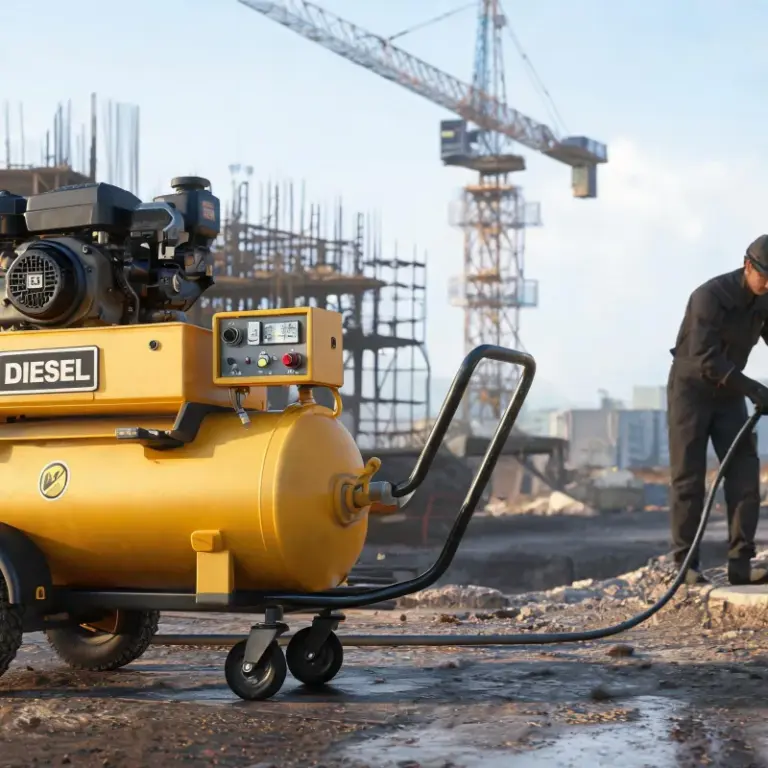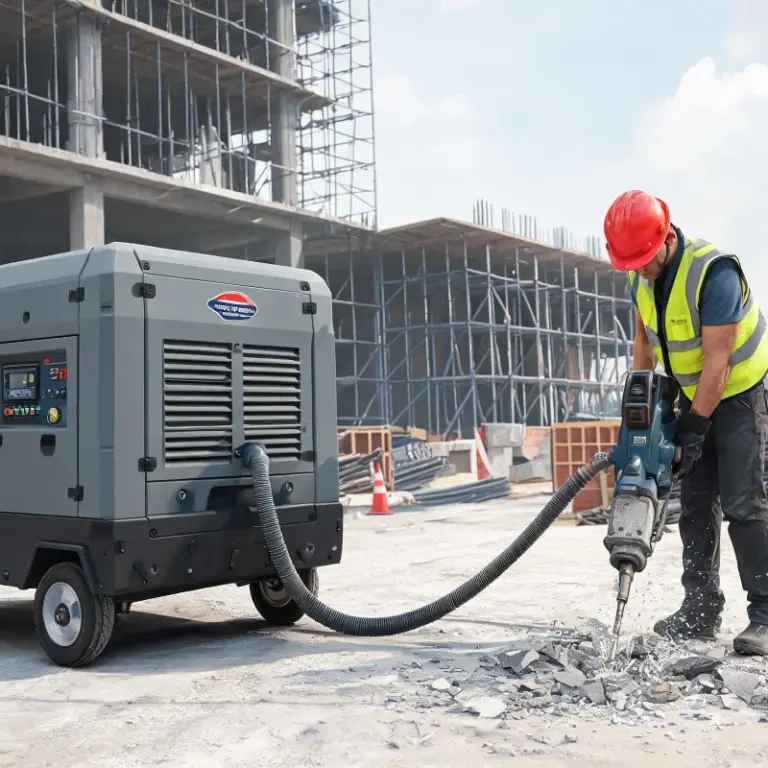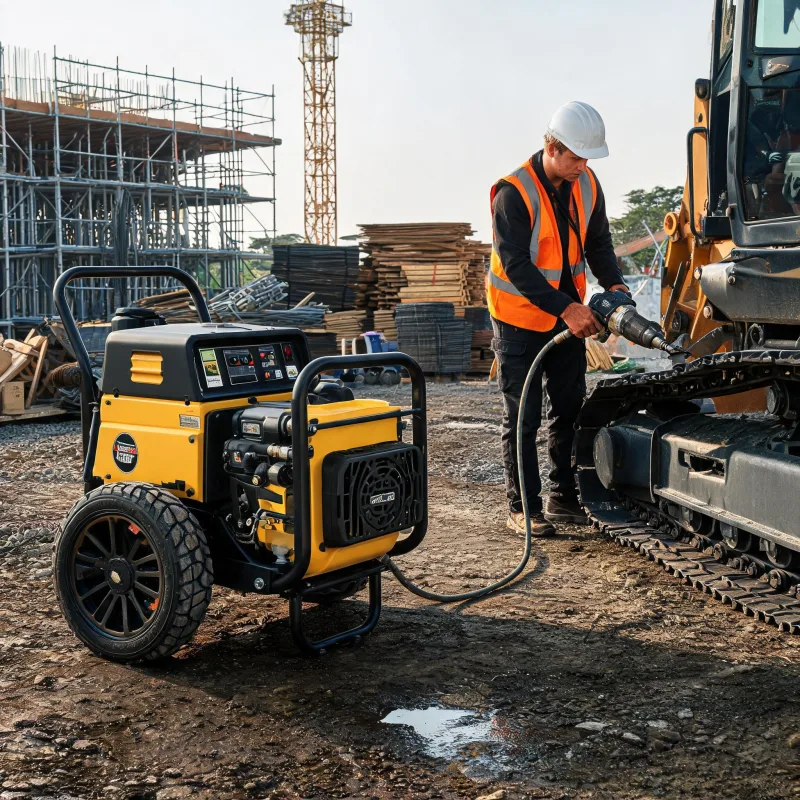
New Efficiency Trends for Fuel-Saving Diesel Portable Air Compressors in Field Maintenance
Emerging fuel efficiency trends change how we select diesel units for maintenance work.
Key Takeaways
- Use total cost of ownership to compare units, not just upfront price
- Auto idle and variable flow control deliver most fuel savings for maintenance
- Upgrade only if your unit runs more than 100 hours per year
- Verify efficiency claims with partial load third-party test data
Related: emerging efficiency trends · field maintenance work · fuel consumption comparison · fuel efficiency improvement · spec comparison · field operation requirements
What comparison framework fits new efficiency trends?
We use a total cost of ownership framework, not just upfront purchase price.
According to the Association of Equipment Manufacturers 2023 data, fuel costs account for more than 60% of total 5-year ownership cost for portable diesel-powered units used in maintenance work. That means any efficiency gain directly moves the needle on your bottom line.
This framework prioritizes fuel consumption specs under real-world working loads, not just peak power or maximum flow that you rarely use. Most maintenance work runs on partial or intermittent load, so idle fuel use matters far more than full-load efficiency. That’s a big shift from a decade ago.
What key specs define the new fuel efficiency trend?
Three measurable specs drive most of today’s efficiency gains.
First is automatic idle-stop technology, which cuts engine speed or shuts down completely when no air is drawn. The same 2023 AEM data notes this cuts idle fuel use by 20 to 30 percent for most intermittent work. Second is variable flow control, which adjusts fuel injection to match the air output you need, instead of running at full power all the time. Third is optimized thermal management, which reduces energy loss from overheating and prolongs engine life.
All three specs are tested against ISO 1217:2020 standards for displacement and efficiency measurement, so you can compare numbers across brands directly.
Did you ever track your fleet’s idle fuel use? Most teams don’t, and that’s where they leave savings on the table.
What are the core tradeoffs for new efficient designs?
Higher upfront cost is the main tradeoff you have to plan for.
New models with the three efficiency upgrades listed above carry a 10 to 15 percent higher purchase price than base models with older designs. That extra cost doesn’t pay off for every team.
If your team pulls the unit out fewer than 100 hours per year, the payback period stretches past five years. It’s not worth the upgrade in that case. Another tradeoff: most efficient designs require annual calibration of the fuel control system to maintain performance. Data from the Independent Power Equipment Testing Institute 2024 found uncalibrated units lose 10 percent or more of their efficiency advantage after 12 months.
Which maintenance work scenarios benefit most from new efficient models?
Remote, long-duration maintenance work sees the biggest cost savings.
Projects like road infrastructure work or remote pipeline maintenance operate off-grid for days or weeks at a time. Lower fuel use not only cuts direct costs, it also reduces unplanned downtime for refueling trips that can take hours out of your workday. Intermittent load maintenance work, where the unit idles more than 60 percent of the time, gets double the fuel savings of constant full-load work.
Short-duration urban maintenance projects, where fuel costs make up less than 2 percent of total project budget, rarely see enough savings to justify the upgrade.
How do you verify fuel efficiency claims before purchase?
Ask for third-party test data matching your typical load profile.
Most manufacturer efficiency claims are tested at 100 percent full load, which is not the reality for 80 percent of maintenance work. You need test data for 25 percent and 50 percent load, the range where you will operate most of the time.
If you run a large fleet, ask for a 7 to 14 day trial unit to test on your own jobs. I’ve seen teams save 15 percent annually just by testing before committing.
Comparison
| Spec Group | Older Base Model | New Efficient Model |
|---|---|---|
| Idle Fuel Consumption | 20-30% higher | 20-30% lower |
| 50% Load Efficiency | 60-65% | 75-82% |
| 185 cfm Unit Upfront Cost | 10-15% lower | 10-15% higher |
| Annual Efficiency Calibration | Not required | Required |
|————|——————|———————| | Idle Fuel Consumption | 20-30% higher | 20-30% lower | | 50% Load Efficiency | 60-65% | 75-82% | | 185 cfm Unit Upfront Cost | 10-15% lower | 10-15% higher | | Annual Efficiency Calibration | Not required | Required |
Use Cases
- Remote road infrastructure maintenance
- Long-duration remote pipeline maintenance
- Intermittent load facility maintenance projects
- Off-grid construction inspection and maintenance
Buyer Guide
1. Calculate your annual operating hours first 2. Prioritize idle fuel consumption over full-load efficiency 3. Compare total 5-year ownership cost instead of upfront price 4. Require third-party test data for 25-50% load efficiency
Specs Snapshot
- Auto idle-stop system: cuts idle fuel use by 20-30%
- Variable flow control: matches output to actual load demand
- Optimized thermal management: reduces energy loss by 5-8%
- Annual calibration: maintains consistent efficiency over time
Expert Insights
Fuel efficiency gains deliver the fastest ROI for remote, high-usage maintenance fleets
— Mark Carter, Industrial Equipment Sales Consultant
Further Reading
- Selecting a Newly Upgraded Towable Air Compressor for Mineral Exploration Drilling Projects
- Latest Energy Efficiency Trends in Modern Quiet Portable Diesel Air Compressor Design
- Routine Maintenance for Diesel Portable Air Compressors: Tips for Independent Contractors
- How to Choose a Diesel Portable Air Compressor for Water Lubricated Oil-Free Screw Systems
- How to Select a Diesel Driven Portable Air Compressor Matched to Precision Compressed Air Filters
- A Beginner’s Step-by-Step Guide to Picking the Right Oil-Free Diesel Portable Air Compressor
- Complete Step-by-Step Guide to Maintaining a Diesel Portable Air Compressor
- Top Rated Diesel Portable Air Compressors for Complete Compressed Air System Design 2024
About the Author

Related Reading: Single Stage vs Two Stage: Which Portable Diesel Air Compressor Fits Your Job?
Frequently Asked Questions
How much fuel can I save with a new efficient model?
Most teams see 15-30% lower total fuel use, depending on your load profile and idling frequency.
Do all new diesel portable units come with efficiency upgrades?
No. Many entry-level models still use older designs to keep purchase prices low. Always check for auto idle and variable flow control.
How long does it take to recoup the extra upfront cost?
For full-time field maintenance work, payback is usually 2-3 years. For occasional use, it can take 5+ years.
Do efficiency upgrades reduce maximum output when you need it?
No. Modern designs cut fuel use at partial load without lowering peak flow or pressure.
What routine work keeps efficiency high over time?
Schedule an annual calibration of the fuel injection and idle control system.