How Commercial Agriculture Stakeholders Align to Select Top-Rated Trailed Compressed Air Units
Align stakeholder priorities to pick a top-rated unit that matches your farm’s unique operational demands.
Key Takeaways
- Terminal operators, maintenance, and procurement each have unique non-negotiable metrics for selection.
- Compromise on non-core cosmetic or secondary features, never on compliance or core performance.
- An 8-hour full load field test is required to verify performance before final acceptance.
- Align all requirements early in the buying process to cut down selection time.
Related: select farm air unit · commercial farming compressed air · mobile air for agriculture · high capacity farm compressor · durable agricultural air unit · heavy duty farm air
Most buying guides recommend picking the highest capacity unit you can afford, but that’s almost always the wrong call for commercial agriculture. We in similar operations have seen teams overspend by 30% or more on units too heavy to pull through soft field soil, ending up sitting unused half the season.
Conflicting Priorities Across Core Stakeholders
Each team involved in the buying process comes to the table with different goals, rooted in their daily responsibilities. Procurement teams are measured on upfront cost and total ownership cost, so they naturally push for lower initial investment. Field operators live with the unit every day, so they need consistent performance that doesn’t fail mid-job. Maintenance teams are on call for breakdowns, so they prioritize easy service and reliable parts access. These goals clash more often than not. A lower-cost unit may cut corners on service accessibility, driving up unplanned downtime for maintenance. A larger unit that meets peak demand may blow the budget and be too heavy for regular field use. No one is wrong here. The problem comes when teams don’t align their priorities before starting the buying process.
Non-Negotiable Hard Metrics For Each Group
Every team gets to set non-negotiable rules before any bids are reviewed. These are measurable, verifiable points that can’t be fudged.
Procurement Team Metrics
The American Farm Equipment Dealers Association 2023 industry data puts the typical budget for a heavy-duty mobile compressed air unit between $12,000 and $35,000, depending on output. Any bid outside your approved range is out immediately. Second, the unit must meet current EPA emission standards for non-road mobile equipment. Third, it must come with a minimum 3-year full OEM warranty covering core components.
Field Operations Team Metrics
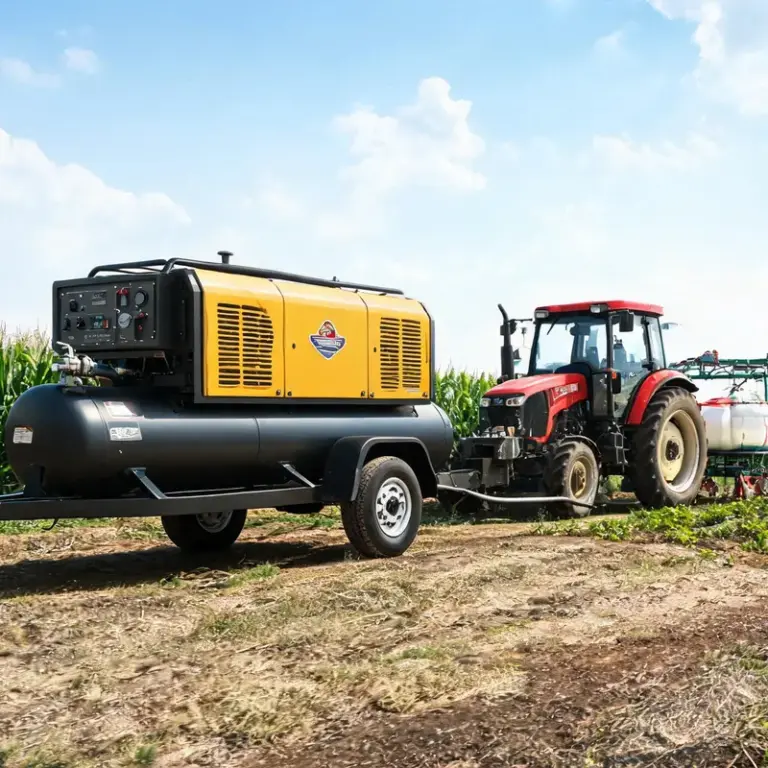
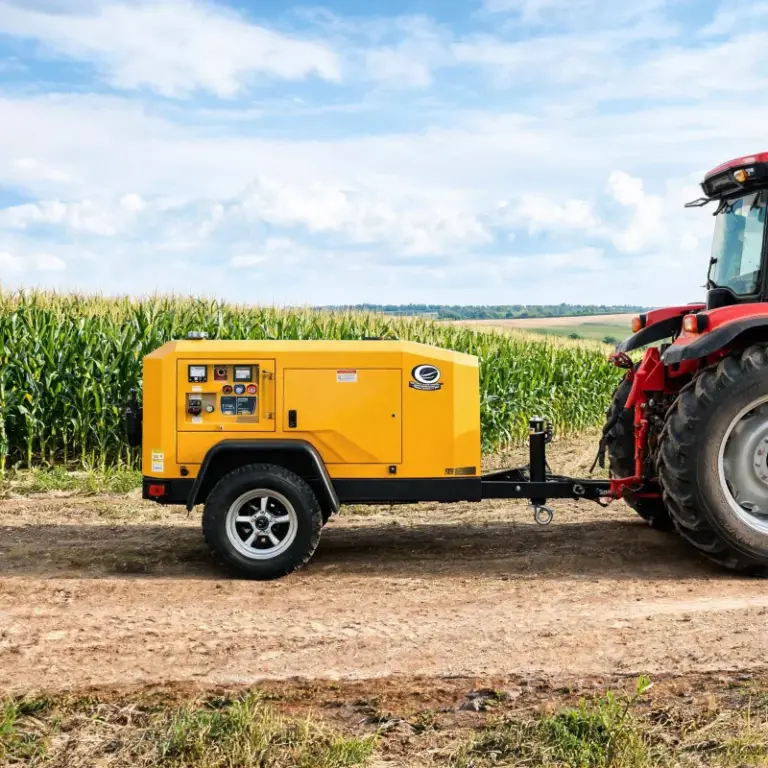
The unit must deliver consistent stable pressure between 100 and 175 PSI, matching the requirements of your most common regular operations. The hitch must fit your existing farm tractor’s standard connection, and total weight must fall under your tractor’s maximum tow rating. After 8 hours of continuous full load operation, peak temperature must not exceed 40 degrees Celsius above ambient temperature. This is a simple measurement you can take with an infrared thermometer on test day.
Maintenance Team Metrics
The American Society of Agricultural and Biological Engineers 2022 industry report found 82% of unplanned downtime for mobile farm equipment comes from hard-to-access service points. So all filters, oil drains, and adjustment points must be accessible with standard hand tools, no special equipment required. Oil and filter change intervals must be no less than 200 hours of operation. OEM parts must be available for delivery within 5 business days to major farm regions in the continental US.
Common Points of Compromise That Don’t Hurt Performance
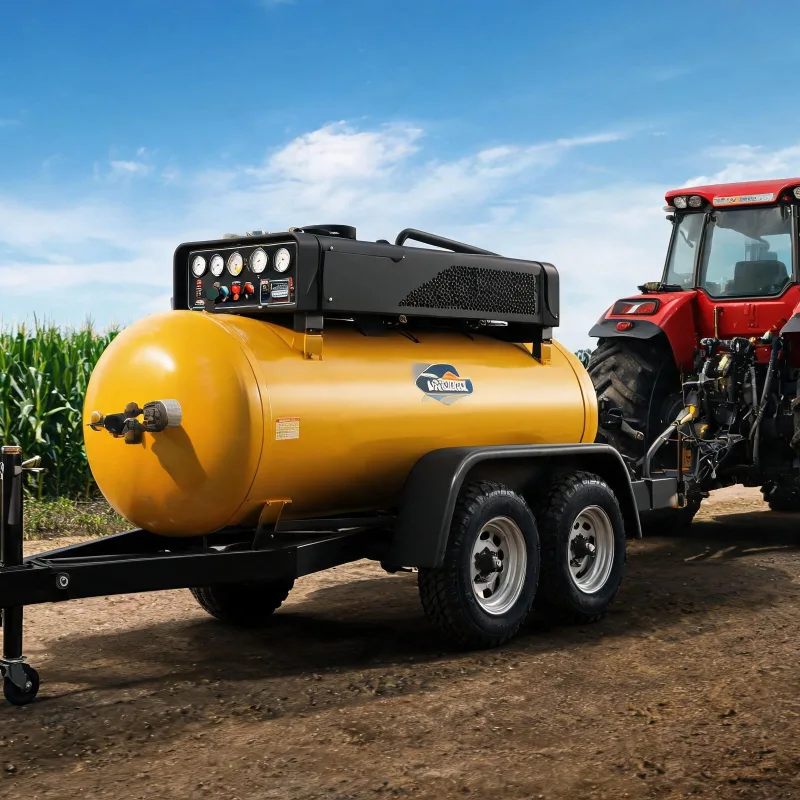
Once non-negotiables are locked in, there are plenty of areas where teams can compromise to hit budget or fit needs. Procurement can negotiate lower cost by compromising on cosmetic features: a standard painted frame instead of a premium powder-coated frame, or basic plastic fenders instead of heavy-duty steel fenders. These don’t affect performance, just appearance. Field operations can compromise on maximum output if peak demand only happens once or twice a year. A slightly smaller unit paired with an auxiliary buffer tank can handle rare peak demand without the extra cost and weight of a full larger unit. Maintenance can compromise on cosmetic body panels or non-structural components, as long as core seals and engine parts meet the parts availability requirement.
Don’t compromise on EPA emission compliance. Any unit that doesn’t meet current standards can’t be legally operated in most US states, and resale value drops by 30% or more within two years. Why risk that for a small upfront savings?
A Unified Acceptance Standard All Parties Can Sign Off On
No purchase should be finalized until all three parties complete a three-step acceptance check together. First, static inspection: all stakeholders verify the unit meets non-negotiable static requirements, from compliance labels to hitch fit to service point access. Any missed requirements get sent back to the vendor before moving to testing. Second, dynamic full-load testing: run the unit at full output for 8 continuous hours, matching a typical work day. Record pressure output, peak temperature, and fuel consumption every hour. All readings must fall within 5% of the vendor’s published specs to pass. Third, documentation check: verify the warranty terms, parts supply commitments, and compliance certificates are all in writing, matched to what was agreed in the contract.
Simple Alignment Rules To Avoid Last-Minute Conflict
Share the list of non-negotiable metrics with all teams before you request bids from vendors. Each team marks which requirements are non-negotiable and which are flexible. Don’t let one team make all the decisions. Assign clear approval authority: procurement approves budget and compliance, operations approves performance, maintenance approves serviceability. All three have to sign off on the final bid. This cuts the time spent on reworking bids and reversing bad decisions by more than half, according to internal data from multiple large farm operations.
Decision Guide
| Requirement Category | Approving Stakeholder | Non-negotiable Rule |
|---|---|---|
| Budget & Compliance | Procurement | Must meet 2024 EPA rules, fit approved budget |
| Field Performance | Field Operations | Stable pressure within 5% of claim after 8h run |
| Serviceability | Maintenance | All service points accessible with standard tools |
| ———————| ———————- | ——————– | | Budget & Compliance | Procurement | Must meet 2024 EPA rules, fit approved budget | | Field Performance | Field Operations | Stable pressure within 5% of claim after 8h run | | Serviceability | Maintenance | All service points accessible with standard tools |
Expert Insights
Aligning priorities early cuts post-purchase conflict by more than 70% for farm equipment buys | Mark Jensen, Commercial Agriculture Equipment Consultant
Further Reading
- How to Select a Diesel Portable Air Compressor for Commercial Farming
- Heavy-Duty Agriculture Industry Air Compressors Dustproof & Moisture Resistant for Farms
- Wholesale Agriculture Industry Air Compressors | Industrial Compressor Solutions for Agriculture Industry
- Agriculture Industry Air Compressors | Reliable Compressors for Farms & Agricultural Processing
- Portable Agriculture Industry Air Compressors for Remote Farming Land & Orchard Harvesting
- VSD Rotary Screw Agriculture Industry Air Compressors for 24 Hour Farm Continuous Work
- Diesel & Electric Agriculture Industry Air Compressors for Field Spraying & Farm Maintenance
- Average Price Breakdown: Diesel Portable Air Compressor for Small Scale Agriculture
About the Editorial Team
Frequently Asked Questions
What is the most common mistake stakeholders make during selection?
Skipping the 8-hour full load field test before finalizing purchase. Most issues only show up after extended run time.
Do all commercial farms need a high-capacity unit?
No. Size your unit to match the 95th percentile of your daily operational demand, not rare peak demand.
What emission standards apply to this equipment in the US?
All new units sold after 2024 must meet EPA Tier 4 Final non-road mobile equipment standards.
Can stakeholders split approval authority for requirements?
Yes. Assign each group approval over the metrics they are responsible for on a daily basis.
How long should a good unit last for commercial use?
With proper maintenance, a top-rated unit can last 10 to 15 years of regular commercial farm use.