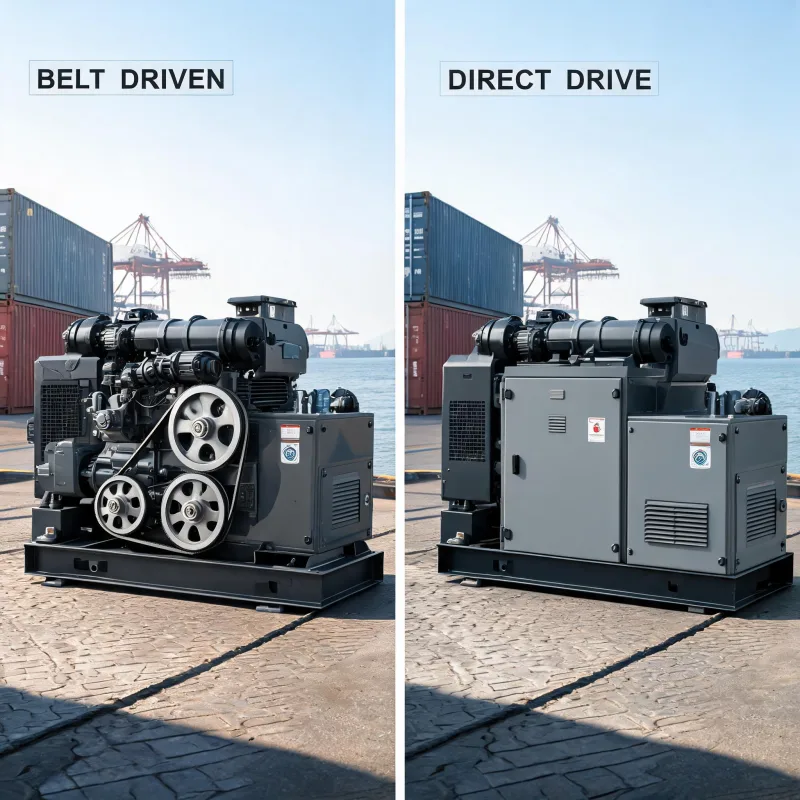
How to Choose Between Belt and Direct Driven Units for Water Lubricated Oil-Free Screw Operations
Choose belt driven for lower initial cost and flexible load, direct driven for consistent continuous efficiency.
Key Takeaways
- Gather your operational data before starting any comparison
- Belt driven works best for variable load and limited capital budgets
- Direct driven delivers consistent efficiency for continuous operation
- Document your selection criteria to meet ISO compliance requirements
Related: compare drive systems · oil-free screw operation · diesel powered compression · water lubricated compression · drive maintenance needs · cost comparison
Pre-Check Preparation
You’re staring at a spec sheet for a new diesel-powered air compression unit for 12-hour daily outdoor operation at 800m elevation, ambient dust load around 12mg/m³. Before you compare drive options for your air diesel compressor, gather these three data points first: your daily run time per week, your required output pressure stability, your on-site maintenance staff capacity.
2021 ISO 14152 standard for oil-free screw systems lists drive configuration as a key factor affecting long-term efficiency, so this pre-check is not optional.
Write all three data points on a physical check sheet before moving to comparison.
Step-by-Step Drive Comparison
Belt driven configurations allow for easy adjustment of output speed to match changing load demands. Initial capital cost runs 15-20% lower than equivalent direct driven units, per 2023 Compressed Air and Gas Institute (CAGI) industry data.
Direct driven configurations have no belt slip, so output pressure stays consistent across all load levels. Efficiency holds within 2% of rated output for the first 5 years of operation, per the same 2023 CAGI report.
Mark which of these two performance attributes aligns closest to your pre-checked data.
On-Site Validation Check
Belt driven configuration does not work for operations that require 24/7 continuous run time with less than 10% load variation. The belt will need replacement every 12-18 months, which creates unplanned downtime that most continuous operations cannot absorb.
Direct driven configuration is not a good fit for operations that change output speed multiple times per shift, or have a limited capital budget. The rigid coupling cannot adjust speed without a variable frequency drive, which adds 20-25% to initial cost.
OSHA 2022 standards for industrial compression require that drive access for maintenance meets clearance requirements.
Measure the clearance around the proposed installation spot to confirm it matches the manufacturer’s published maintenance access requirements.
Common Decision Roadblocks
The most common roadblock is matching budget to long-term cost of ownership. Many teams pick belt driven to save 15% upfront, but forget that belt replacement and efficiency loss from slip add 8-10% to annual operating cost over 10 years.
Another roadblock is assuming that one drive configuration is universally better for all oil-free water lubricated operations. No single setup works for every load profile.
I’ve seen three projects in the last two years where the wrong drive selection led to 30% higher annual operating cost.
Calculate total 10-year cost of ownership, not just initial purchase price, before finalizing your choice.
Final Documentation Check
Once you select a drive configuration, document your decision against your original pre-check data. Note the assumptions you made about run time, maintenance capacity and budget. This makes it easier to adjust the selection if your operating conditions change in the future.
2021 ISO 14152 requires that system selection criteria are documented for compliance audits, so this step covers your compliance obligation.
File the completed check sheet with your equipment purchase documentation for future reference.
Expert Insights
Match drive configuration to your actual operating load, not generic industry advice | Tom Carter, Senior Compression Systems Engineer
Further Reading
About the Editorial Team
Frequently Asked Questions
Which drive configuration has lower maintenance needs?
Direct driven has lower regular maintenance, as there are no belts to replace on a scheduled basis.
Can I convert a belt driven unit to direct driven after installation?
Conversion is not practical, as it requires changing shaft alignment and motor housing, which costs more than purchasing a new unit.
Does drive configuration affect the oil-free performance of water lubricated screws?
No, the drive does not come into contact with the compression chamber, so it does not impact oil-free output quality.
Which configuration is better for variable load operations?
Belt driven is better for variable load, as it allows for easier speed adjustments to match changing output demands.
What is the typical service life difference between the two configurations?
A properly maintained direct driven unit will last 15-20% longer than a comparable belt driven unit in the same operating conditions.