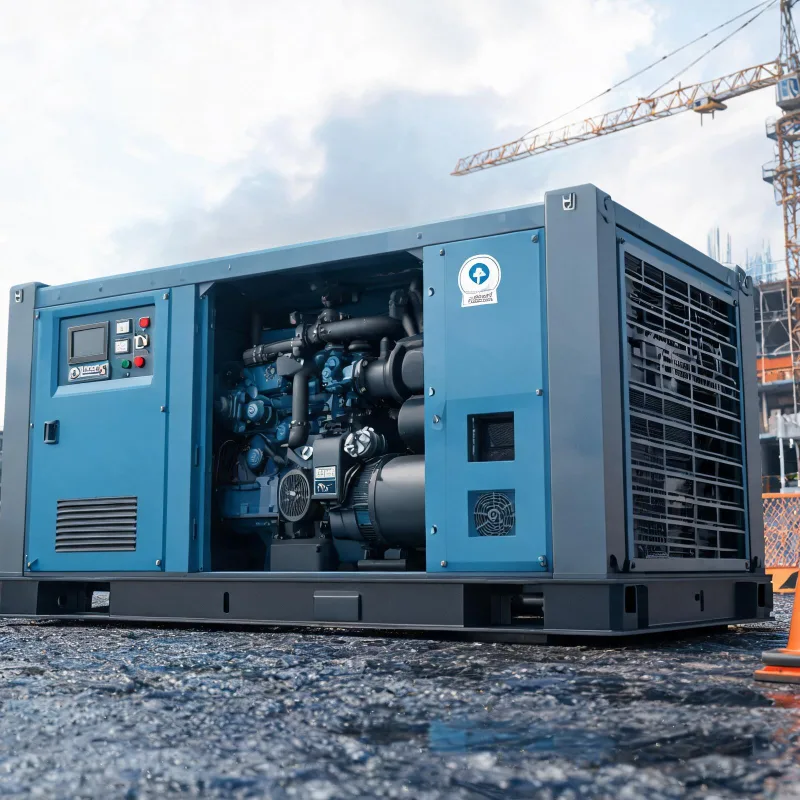
Sourcing & Commissioning Checklist for New Diesel-Powered Water-Lubricated Industrial Compressors
This step-by-step checklist helps you verify specs, compliance and performance for new units before final acceptance.
Key Takeaways
- Verify all documentation and emissions compliance before signing a purchase contract
- Size power output to 90th percentile site demand to cut long-term fuel waste
- Complete three on-site performance checks before signing off on acceptance
- Lock in spare parts availability and rotor warranty in contract clauses
Related: industrial compressed air · diesel powered compressor · oil-free compression · water lubricated screw · new industrial equipment · sourcing verification
Do you have all pre-sourcing verification documents ready?
No, most teams only collect the basic spec sheet before ordering. That’s the first mistake.
You need three core documents before signing a contract, aligned with the 2023 ISO 1217 standard for displacement and efficiency testing for compressed air equipment. First, confirm the stated continuous power output of the diesel engine matches the peak load required for your site’s longest run cycle. Most new units advertise peak output, but continuous output is often 10-15% lower.
The tradeoff here is between upfront cost and long-term energy use: undersizing the unit will force it to run at overload, cutting 20% off service life per 2022 Compressed Air and Gas Institute (CAGI) data. Oversizing wastes fuel on every cycle. Second, request a factory test report for the water lubrication system. Unlike oil-injected models, this system relies on water to cool and lubricate rotors, so any misalignment in factory testing will lead to rotor wear within 12 months. Third, confirm emissions documentation matches your regional regulatory requirements for 2024 off-road diesel equipment. You can’t correct this after delivery.
This checklist only applies to new units purchased for permanent or semi-permanent industrial installation. If you’re moving the unit between sites weekly, the verification process is different, and this guide won’t cover your mobility-related requirements.
Have you matched power output to your site’s actual compressed air demand?
Most teams size based on absolute peak demand alone, which wastes 15-20% of annual fuel.
The core tradeoff here is between peak reserve and continuous energy efficiency. New launched models offer variable rotor speed matched to diesel engine output, but this adds 8-12% to upfront cost. Calculate your site’s 90th percentile demand instead of absolute peak. Most sites only hit absolute peak 2-3 times a year, so carrying extra capacity full time is a waste. 2023 CAGI data shows that sizing to 90th percentile demand with a 10% reserve cuts annual fuel use by an average of 18% compared to oversizing.
If your demand swings more than 30% over a single shift, variable speed is worth the extra cost. If your demand stays steady within 10% most of the time, fixed speed will give you better total cost of ownership. No one-size-fits-all answer exists here, even for new models with upgraded technology.
What on-site checks do you need to complete before acceptance?
Three non-negotiable checks that most commissioning teams skip entirely.
First, check the rotor clearance after the unit is unloaded and leveled. Transport can shift alignment, even for new units straight from the factory. Run the unit unloaded for 30 minutes, then check the outlet oil content. It should read zero, since this is an oil-free design. If you get any measurable oil content, the shaft seal is damaged, and you need a replacement before signing off.
Second, test the water filtration system. Water lubrication requires filtered water with less than 50ppm total dissolved solids, per 2022 ISO 8573-1 standard for clean compressed air. If your site water is hard, you need to confirm the integrated filtration system meets that spec before acceptance.
Third, test fuel consumption at continuous full load. Compare the on-site test result to the factory stated spec. A variance of more than 5% means the unit has a tuning issue that will add thousands to your operating costs over time. I’ve seen teams sign off on units with 12% higher fuel consumption just because the unit ran, that’s a $10k+ mistake over five years.
What contract clauses do you need to verify before final payment?
Three clauses that protect you from underperforming units that meet marketing specs but not real-world needs.
First, add a performance acceptance clause that ties 10-15% of final payment to measured fuel consumption and oil-free output. If the unit doesn’t meet the stated specs within a 5% variance, you can reject it or require the supplier to adjust it at their cost.
Second, confirm that the rotor assembly warranty is at least 10 years for new launched units. Most suppliers offer 5 years, but the water lubricated rotor design has a demonstrated 20+ year service life when properly maintained, so 10 years is a reasonable requirement.
Third, confirm that spare parts for the diesel engine and water filtration system will be available for at least 15 years. Many new launched models have short production runs, and you don’t want to be stuck with a unit you can’t support after 5 years. If the supplier can’t commit to 15 years of parts, negotiate a spare parts package for the first 10 years included in the purchase price.
What post-acceptance checks do you need to schedule in the first 90 days?
Two scheduled checks to catch issues before they cause unplanned downtime.
First, schedule a rotor clearance check after 100 hours of operation. Wear seats in the first 100 hours, and if clearance is outside the factory spec, you can file a warranty claim before the end of the initial break-in period. Waiting longer than that can leave you responsible for repair costs even if the damage was from factory error.
Second, test the compressed air quality again after 500 hours of operation. Water quality can build up deposits over the first few months, and this can affect output and purity. If you’re supplying compressed air for food processing or pharmaceutical manufacturing, this test is required by regulation anyway, but even for general industrial use, it catches early wear before it becomes catastrophic.
Implementation Checklist
- Collect factory test report and emissions documentation
- Confirm power output matches 90th percentile site demand
- Check rotor alignment after unit installation
- Run 30 minute unloaded test and oil content check
- Run full load fuel consumption test
- Verify warranty and spare parts clauses before final payment
- Schedule 100 hour and 500 hour post-acceptance checks
Implementation Timeline
1. Pre-order (2 weeks before deposit): Complete document and demand sizing check 2. Delivery (day of unload): Inspect shipping damage, confirm unit alignment on foundation 3. Commissioning (1-2 days after installation): Complete all performance tests 4. 100 hours of operation: First follow-up check 5. 500 hours of operation: Second follow-up check
Further Reading
- Budgeting for Industrial Water-Lubricated Oil-Free Screw Diesel Compressors: A Full Breakdown
- How Diesel-Powered Air Compression Drives Water-Lubricated Oil-Free Screw Systems: Spec Selection
- Installation Guide: Pairing Diesel-Powered Portable Air Compressor With Water-Lubricated Oil-Free Screw Units
- Top Rated Portable Diesel Compressors for Water Lubricated Oil-Free Screw Systems
- Field Notes: Powering Water-Lubricated Oil-Free Screw Systems With Diesel Air Compression
- Diesel Portable Air Compressor vs Electric Stationary Water-Lubricated Oil-Free Screw: Which To Pick
- Diesel Portable Solutions for Off-Grid Water Lubricated Oil-Free Screw Operation
- Why Does My Diesel Portable Air Compressor for Oil-Free Screw Units Keep Shutting Off
About the Editorial Team
Related Reading: How Zero Contamination Rules Are Changing Diesel Powered Oil-Free Compressor Sourcing
Frequently Asked Questions
What’s the biggest energy waste when sizing a new unit?
Oversizing to match rare peak demand, which increases annual fuel use by 15-20%. Size to 90th percentile demand with a 10% reserve instead.
Do new water lubricated units require special water quality?
Yes, most require water with less than 50ppm total dissolved solids, per international clean air standards. Test your site water before installation.
Is variable speed always worth the extra upfront cost?
Only if your site’s compressed air demand swings more than 30% over a typical shift. For steady demand, fixed speed has lower total cost.
What global standard covers performance testing for these units?
The 2023 updated ISO 1217 is the global standard for displacement and efficiency testing.
Can I skip the full load fuel test after installation?
No. Factory tests are done under controlled conditions, and on-site tuning can cause large fuel consumption variances.