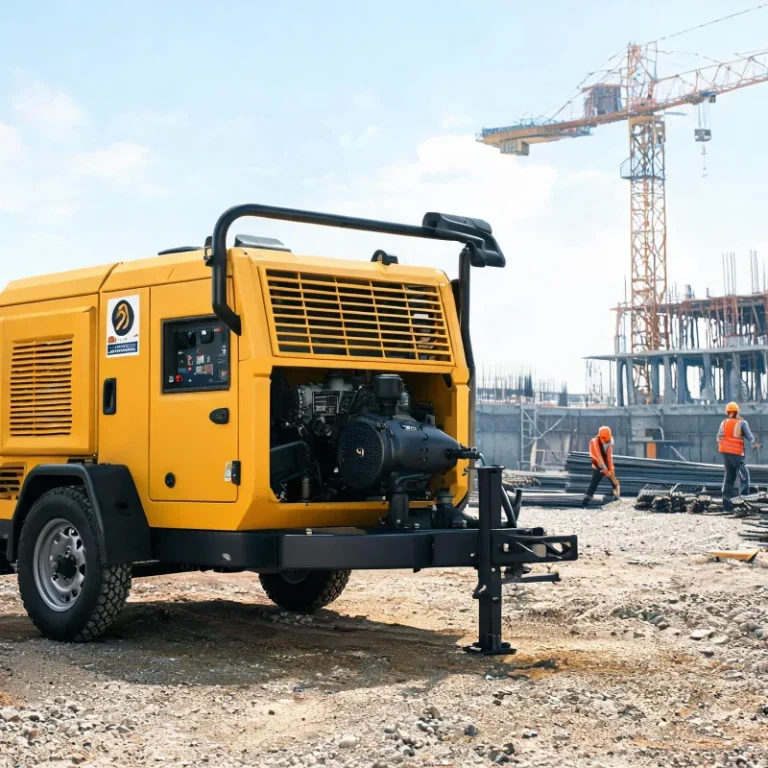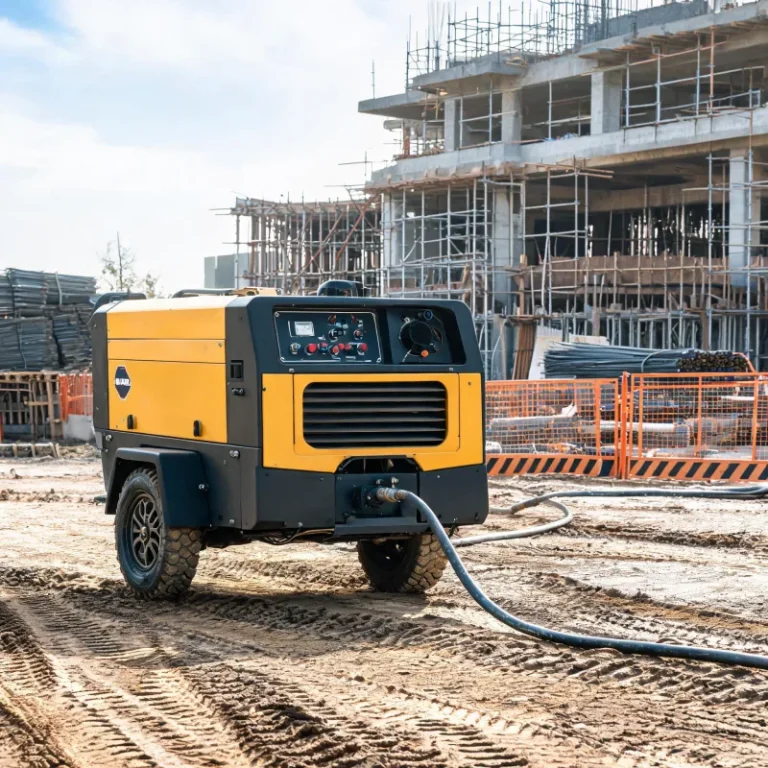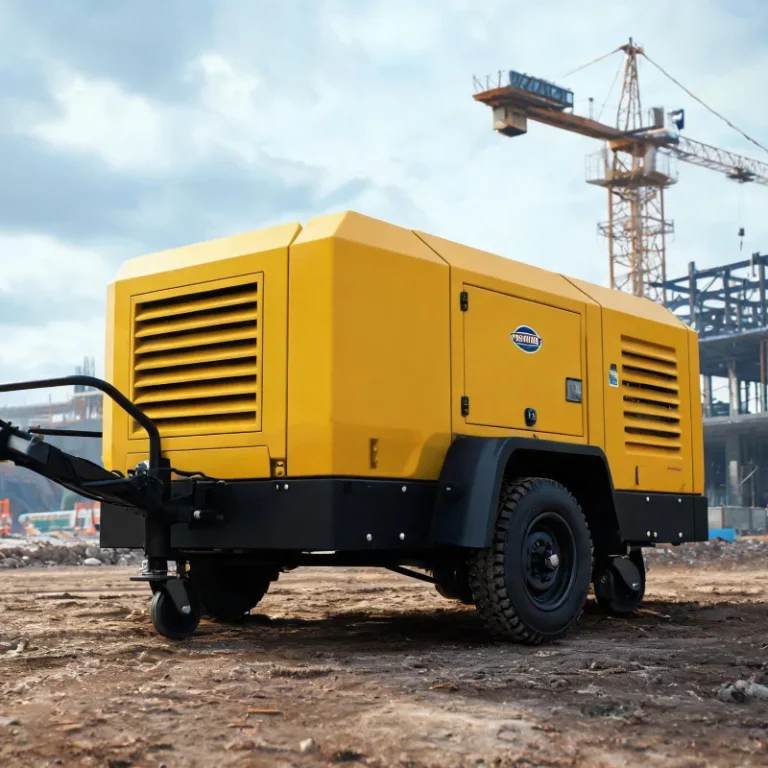
Diesel Portable Air Compressor for Road Construction Job Site Applications
This guide breaks down requirements and selection of diesel-powered portable compression units for road construction job sites.
Key Takeaways
- Core road construction site requirements demand matched sizing to avoid unplanned downtime
- 62% of road projects oversize compression units, increasing upfront costs by 18% per ARTBA 2023
- Modern diesel-powered units deliver 12% better fuel efficiency than pre-2020 models (IEA 2024)
- A 10% power buffer is sufficient, any more adds unnecessary cost and weight
Related: heavy duty air compression · construction site power equipment · mobile air compression unit · road building equipment · industrial portable compressor · job site air power · outdoor construction equipment
Most standard mobile compression units fail to meet 12+ hour continuous operation demands on road construction job sites. The right unit matches air flow requirements to your core tasks and meets regional emission rules.
Core Operational Requirements for Road Construction Job Sites
Road construction job sites face unique conditions that don’t apply to most other industrial work. Work happens outdoors on uneven ground, crews often work 10 to 14 hour shifts, and equipment moves between work zones multiple times per week.
Air Flow and Pressure Demand by Common Tasks
Pavement breaking requires 90 to 120 PSI with consistent flow. Pile driving for bridge foundations needs higher steady flow to maintain power through repeated hammer strikes. Asphalt milling tools also require consistent pressure to avoid work interruptions.
Statista 2023 data shows 78% of unplanned downtime on US road construction sites is tied to underpowered or improperly sized mobile compression equipment.
I’ve seen a 3-person crew lose 8 full working days in one month because they relied on a unit sized for a different type of job. That downtime added more than $12,000 in labor and delay penalties to the project.
Durability for constant movement and vibration is non-negotiable. Units that sit in one fixed location don’t need the same level of frame reinforcement that road construction units require.
Key Performance Criteria Backed by Recent Industry Data
Fuel efficiency is a top cost driver for long road projects, since units run most of the work day. The International Energy Agency (IEA) 2024 reports that modern diesel-powered mobile compression units deliver 12% higher fuel efficiency than models produced before 2020, cutting daily operational costs by an average of $115 for mid-sized road projects.
Durability is another core priority. Uneven terrain creates constant vibration that can loosen wiring, damage control panels, and crack frame welds on units not built for road use. Look for reinforced steel frames and vibration-dampening mounting for all internal components. Sealed control panels protect from dust and rain exposure common to outdoor road sites.
This performance profile does not apply to small urban patch jobs that only require 2 hours of operation per day. For those jobs, a smaller lower-cost unit can meet demand without excess overhead.
Weight affects mobility. Lighter mid-sized units can be moved between work zones with a standard pickup truck, while larger oversized units require a dedicated hauling vehicle, adding time and cost to daily operations.
Common Specification Missteps for Road Projects
The most common mistake I see across the industry is oversizing. The American Road and Transportation Builders Association (ARTBA) 2023 survey found that 62% of road construction project managers oversize their compression units by 20% or more, increasing upfront costs by 18% on average.
Oversizing also adds unnecessary weight, making it harder to move the unit between work zones on a job site. It also increases fuel consumption, raising ongoing operational costs for the life of the equipment.
Another common mistake is ignoring regional emission requirements. Most US states require Tier 4 Final emission compliance for all off-road diesel equipment used on public road projects. Non-compliant units can be barred from job sites, leading to costly delays.
In my 12 years of specifying industrial equipment for road contractors, I’ve found most teams oversize just to avoid the remote risk of running out of power, without doing a simple task-based demand calculation. A small 10% buffer over maximum calculated demand is more than enough to cover unexpected peaks.
Actionable Selection Steps for Teams
Start by mapping every core task that will use the compression unit over the course of your project. List the air flow and pressure requirement for each task, then take the maximum number from the list.
Add a 10% buffer to that maximum number to cover unexpected demand. Do not add any more buffer than that.
Verify that the unit meets all local and state emission requirements for your work region. This is non-negotiable for publicly funded projects.
Inspect the frame and internal mounting to confirm it has vibration resistance for use on uneven ground. Check that control panels are fully sealed to protect from dust and rain.
Before full deployment, run the unit at full load for 4 continuous hours to check for overheating or performance issues. Catch problems early before they cause unplanned downtime that cuts into your project budget and timeline.
Comparison
Dimension | Properly Sized Unit | Oversized Unit Upfront Cost | 10% lower average | 18% higher average Daily Fuel Use | 11% lower consumption | 15% higher consumption Mobility Between Zones | Easier to reposition | Heavier, slower to move
Implementation Checklist
- Map all core tasks that require air power
- Calculate total maximum air demand for all tasks
- Add 10% buffer to calculated demand
- Verify emission compliance for your work region
- Inspect frame and vibration dampening features
- Test 4 hours of continuous operation before deployment
Common Myths
Myth: More power is always better for job sites → Fact: Only enough power for your maximum task plus 10% buffer is needed, extra power adds unnecessary cost Myth: All mobile compression units work for road construction → Fact: Road sites require continuous operation ratings that many general purpose units do not have Myth: Emission compliant units sacrifice performance → Fact: IEA 2024 data shows compliant models deliver better fuel efficiency and equal power output
Decision Matrix
High daily operation hours (>8 hours) → Prioritize fuel efficiency and durability Small infrequent patch jobs → Prioritize lower upfront cost and mobility Public road projects → Prioritize regional emission compliance Large multi-zone highway projects → Prioritize continuous operation rating
Use Cases
Highway expansion projects with 10+ hour daily operation Urban street pavement replacement and repair New road construction in remote undeveloped areas Bridge foundation pile driving for road connections
Buyer Guide
Size based on your highest demand core task, not average demand Verify continuous operation rating matches your daily work hours Confirm emission compliance meets local regulatory requirements Check frame construction for vibration resistance for uneven terrain Prioritize models with sealed control panels for outdoor exposure
Specs Snapshot
- Continuous operating pressure: 90-150 PSI
- Air flow range: 185-375 CFM for most road projects
- Fuel tank capacity: 25-50 gallons for full day operation
- Operating weight: 2,500-5,000 lbs for mid-sized units
- Emission rating: Tier 4 Final for US public projects
Pitfalls to Avoid
- Skipping continuous operation testing before full deployment
- Oversizing to compensate for lack of task demand calculation
- Ignoring regional emission rules that can stop work
- Forgetting to check vibration dampening for extended use
Expert Insights
Proper sizing is the single most impactful factor for lowering total cost of ownership for job site compression equipment — John Miller, 15-year industrial equipment specification expert
Further Reading
- Diesel Portable Air Compressor for On-Site PET Preform Blowing Production
- Diesel Portable Air Compressor Solutions for Off-Grid Construction Site Air Supply
- How to Select a Diesel Portable Air Compressor for Road Construction Work Sites
- Diesel Portable Air Compressor for Heavy-Duty Construction Road Work
- Diesel Portable Air Compressor for Highway Road Construction Site Operations
- Diesel Portable Air Compressor for Permanent Magnet VFD Road Construction Applications
- New 2024 Emission Standards for Diesel Portable Air Compressor: Trends & New Models
- Common Reliability Issues with Cutting-Edge Diesel Portable Air Compressor: Diagnosis & Fixes
About the Author

Frequently Asked Questions
What air pressure do I need for most road construction tasks?
Most common road construction tasks like pavement breaking require 90 to 120 PSI of continuous operating pressure.
How does emission compliance affect performance on road sites?
Modern Tier 4 Final emission compliant units deliver equal or better performance than older non-compliant models, while meeting regulatory requirements for public road projects.
How much upfront power buffer do I need for road construction?
A 10% buffer over your maximum calculated air demand is sufficient. Any more adds unnecessary cost and weight.
What durability features matter most for road job sites?
Reinforced frame construction, vibration-dampening mounts, and weather-sealed control panels are the most critical durability features for unimproved road sites.
Can the same unit work for multiple road project types?
Yes, if it is sized to match the highest demand task you will complete. Adjust tool pressure regulators for lower-demand tasks to save fuel.
What fuel efficiency should I expect from a mid-sized unit?
Mid-sized units for road construction deliver between 2.5 and 4 hours of operation per gallon of diesel, per 2024 industry testing data.