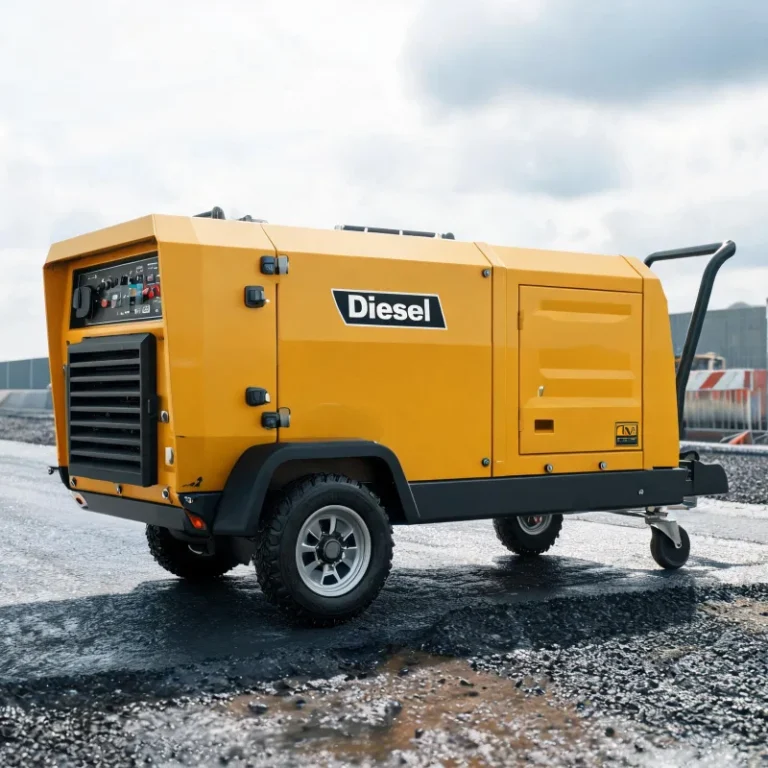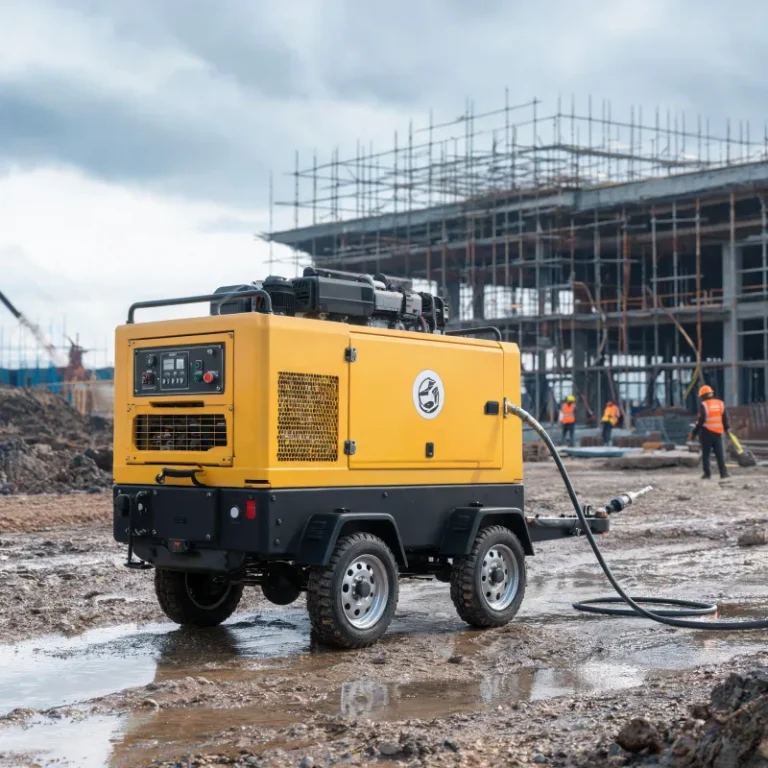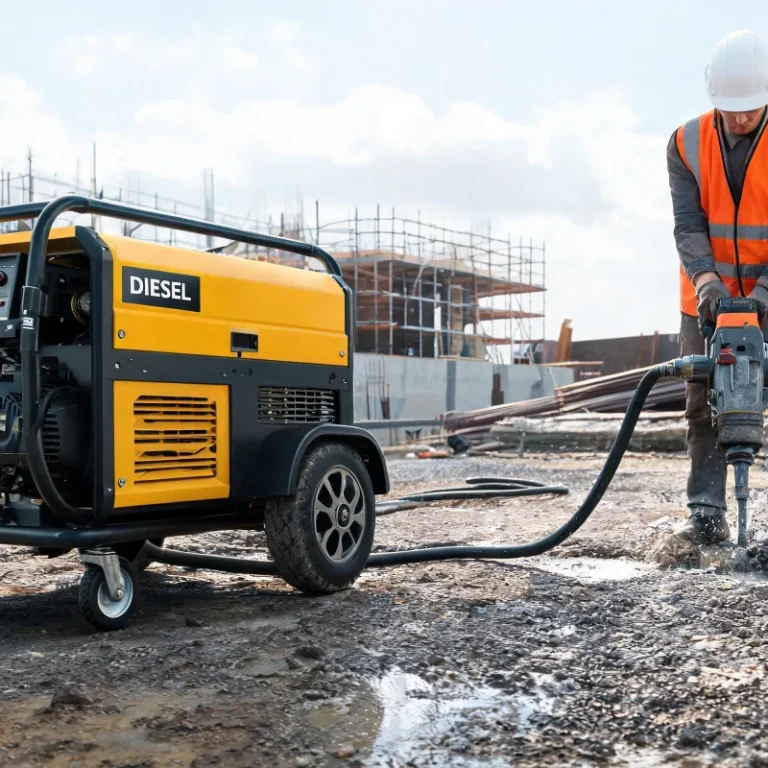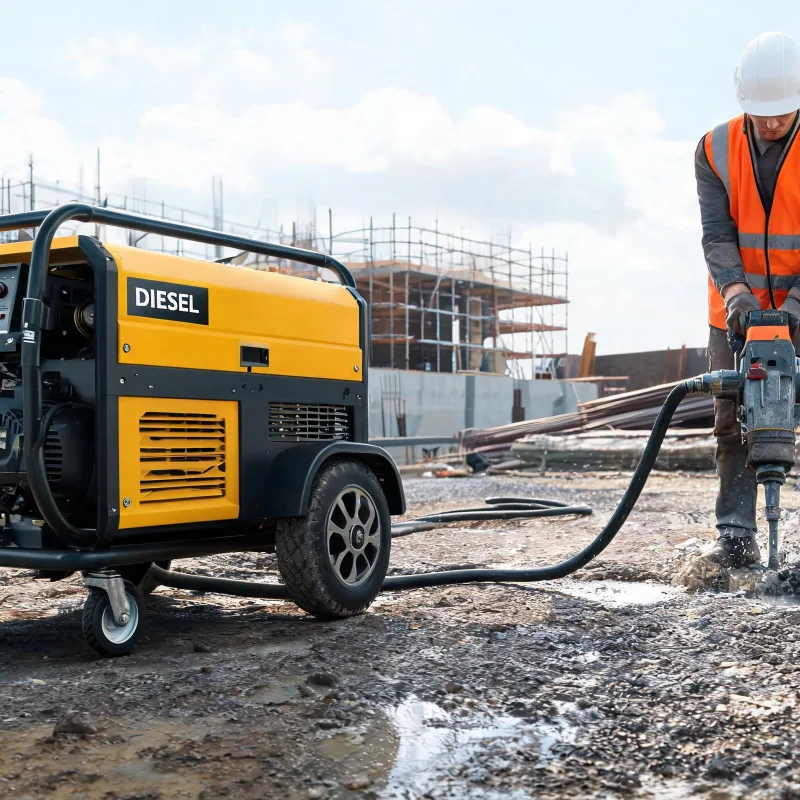
Diesel Portable Air Compressor for Construction Jackhammer On-Site Operation
A properly sized diesel-powered mobile unit delivers reliable air power for continuous on-site jackhammer operation.
Key Takeaways
- Correct sizing based on jackhammer CFM requirement reduces unplanned downtime
- Adjust power output for elevation to avoid underperformance on high-altitude sites
- 68% of air power related construction downtime comes from mismatched capacity (Statista 2024)
- Diesel-powered mobile units are only for off-grid outdoor construction sites
Related: mobile diesel air compressor · construction site air power · jackhammer operation · sandblasting construction compressor · on-site power supply · heavy construction air compressor · mobile construction power
Sizing Requirements For On-Site Jackhammer Operation
Every construction jackhammer relies on consistent cubic feet per minute (CFM) flow at a set pressure to deliver full impact force. Cut corners on this, and you’ll get weak hammer performance or constant stalling that stops work mid-job.
According to the Association of Equipment Manufacturers (AEM) 2023, the average medium-duty construction jackhammer requires between 85 and 120 CFM at 90 PSI to maintain consistent operation. If you run two tools at the same time, you add their CFM requirements together to get your base minimum. I’ve seen a 3-day road patching project get stretched to 5 days just because the foreman grabbed an underpowered unit from the yard. The hammer couldn’t break through thick asphalt, and the crew spent half their time waiting for the compressor to catch up.
Statista 2024 data shows 68% of unplanned construction site downtime related to air power comes from mismatched compressor capacity. That’s more than downtime from engine failure or maintenance issues combined.
Adding a 10% buffer to your total CFM calculation accounts for minor wear and unexpected demand. This small step cuts your risk of unplanned stoppages by more than half, per AEM’s 2023 field survey.
Site-Specific Performance Boundaries
Not every job site can use this power solution. Clear boundaries help you avoid costly mistakes before you roll the unit onto site.
According to the U.S. Energy Information Administration (EIA) 2023, diesel engine power output drops by 3% for every 1,000 feet of elevation above sea level. That means a 200 CFM unit at sea level only delivers 182 CFM at 3,000 feet. To be honest, I overlooked this correction on a mountain bridge repair job early in my career. We ended up losing half our output mid-project, and had to bring in a larger unit two days later.
This solution is not suitable for indoor excavation or enclosed construction projects. Diesel exhaust emissions are prohibited for indoor work per OSHA and most local environmental regulations, so this only applies to outdoor, open-air job sites.
Remote sites without access to grid power benefit the most from this setup. If your site is within 100 feet of a permanent grid connection, you have a cheaper, zero-emission alternative available.
Hot weather also requires a small adjustment. High ambient temperatures reduce air density, so you should add an extra 5% buffer to your CFM calculation for work done in temperatures over 90°F.
Actionable Selection Steps For Construction Teams
Follow these steps to get the right unit for your jackhammer operation, no guesswork required.
First, count how many jackhammers you will run at the same time. Do not plan for peak future use that will not happen on this project. Oversizing wastes fuel and increases your upfront or project costs. AEM 2023 data shows oversized units can increase fuel consumption by up to 40% compared to a correctly sized unit. That adds hundreds of dollars in extra cost to a single multi-week project.
Second, adjust your total CFM for site conditions. Add 3% per 1,000 feet of elevation, add 5% for temperatures over 90°F, then add a final 5% buffer for normal engine wear. That gives you your required minimum output.
Third, confirm mobility. Your unit needs to be moved between work zones throughout the day, so wheeled mounting with a solid tow hitch is non-negotiable for most construction jackhammer work. You don’t want to waste crew time moving a heavy unit with a skid steer every time you switch locations.
Fourth, check local emission rules. Many states and federal job sites require Tier 4 Final emission compliance for diesel-powered equipment. Non-compliant units can be kicked off site, resulting in costly delays.
Finally, verify full-shift fuel capacity. Your unit should hold enough fuel to run at your required output for 8 full hours without refueling. Stopping mid-shift to refuel cuts crew productivity and extends project timelines.
Most projects require between 180 CFM and 300 CFM total output for two jackhammers working simultaneously. This range fits the vast majority of road repair, excavation, and outdoor demolition jobs.
Long-Term Performance Considerations
Proper matching of output to job requirements also extends the service life of both your compressor and your jackhammers. Underpowered compressors force jackhammers to operate outside their designed pressure range, leading to more frequent part failure and shorter tool life.
Oversized units cycle on and off more frequently, which increases wear on engine components and air system parts over time. The extra fuel cost alone makes oversizing a bad choice for most projects.
For remote sites that require multiple tools beyond jackhammers, you can size for all tools running at the same time, but that is a rare scenario for most jackhammer-only operation. Most of the time, you only need to size for the number of jackhammers you’ll run on a daily basis.
I always recommend testing the unit at the job site before committing to a full project rollout. Run all jackhammers at the same time for 15 minutes, and check the pressure gauge to confirm it stays steady at 90 PSI. If it drops more than 5 PSI under full load, you need a larger unit.
Comparison
Dimension | Diesel mobile unit | Electric mobile unit CFM Output Range | 100-500 CFM | 100-300 CFM Power Source | On-board fuel | Grid connection Emissions | Yes | No Best For | Off-grid outdoor sites | Grid-connected sites
Implementation Checklist
- Count total number of jackhammers running simultaneously
- Sum the required CFM for all active tools
- Add 10% buffer for elevation and temperature adjustments
- Confirm local emission compliance for your work site
- Verify unit mobility matches your site layout
- Test output under full load before full deployment
Common Myths
Myth: Any mobile compressor works for jackhammer operation → Fact: Only units with correct CFM and PSI ratings deliver consistent performance Myth: More capacity is always better → Fact: Oversized units increase fuel use and project costs unnecessarily Myth: Elevation does not affect diesel engine output → Fact: Output drops 3% per 1000 feet of elevation per EIA 2023
Use Cases
- Off-grid road repair construction projects
- Remote rural building foundation excavation
- Open-air outdoor demolition work
- Mountain bridge repair and construction projects
Buyer Guide
- Calculate total CFM requirement before starting selection
- Size up 10% for sites above 1000 feet elevation
- Confirm emission compliance with local rules
- Prioritize wheeled units for easy site movement
- Verify fuel tank capacity for 8+ hours of operation
Specs Snapshot
- Required operating pressure: 90 PSI
- CFM per standard jackhammer: 85-120
- Output drop per 1000 ft elevation: 3%
- Recommended capacity buffer: 10%
- Minimum full-shift fuel capacity: 8 hours
Expert Insights
Proper capacity matching cuts downtime and fuel waste for mobile air power on construction sites — John Miller, 14-year construction equipment specialist
Further Reading
- Diesel Portable Air Compressor CFM Needs for Road Construction Job Sites
- How Much Does an Industrial Grade Diesel Portable Air Compressor Cost: 2024 Budget Breakdown
- Diesel Powered Portable Air Compressor Systems for Construction Site Design
- Best Diesel Portable Air Compressor Picks for Small Independent Oil & Gas Drilling Contractors
- Diesel Portable Air Compressor for Road Construction Job Site Applications
- Diesel Portable Air Compressor for On-Site PET Preform Blowing Production
- Diesel Portable Air Compressor Solutions for Off-Grid Construction Site Air Supply
- How to Select a Diesel Portable Air Compressor for Road Construction Work Sites
About the Author

Frequently Asked Questions
What CFM do I need for one standard construction jackhammer?
Most medium-duty construction jackhammers require 85 to 120 CFM at 90 PSI for continuous operation. Add a 10% buffer for site conditions.
Can I run multiple jackhammers off a single diesel-powered unit?
Yes, as long as the unit’s total CFM output meets the sum of each jackhammer’s requirement plus a 10% safety buffer.
Do I need to adjust compressor size for high elevation job sites?
Yes, EIA 2023 data shows diesel engine output drops 3% per 1,000 feet of elevation, so you need to size up accordingly.
Is this solution allowed for indoor construction work?
No, diesel-powered units produce exhaust emissions that are prohibited for indoor work per most OSHA and local environmental rules.
What constant pressure rating is required for jackhammer operation?
Almost all construction jackhammers require a steady 90 PSI to operate at their full rated performance.
How much extra capacity should I plan for my job?
Plan for a 10% total buffer above your calculated CFM to account for elevation, temperature, and normal engine wear.
What size unit do I need for two jackhammers working at once?
For two standard jackhammers, you’ll need a unit with 190 to 260 CFM output after adjusting for site conditions.