Solutions for Rust and Water Accumulation Inside Air Receiver Tanks
Solutions for Rust and Water Accumulation Inside Air Receiver Tanks
Key Takeaways
- 78% of unplanned air compressor shutdowns tie to tank moisture (CAGI 2023)
- 12% of OSHA pressure vessel failures stem from internal tank corrosion (OSHA 2024)
- Proper maintenance improves system efficiency by 15-20% (Statista 2023)
- Solutions do not apply to tanks with over 20% wall thickness loss
- Top solutions include drain adjustment, coating, upgrades and inspections
Related: air compressor common fault troubleshooting · compressed air system maintenance · industrial air receiver tank care · drain valve maintenance · tank internal coating replacement · compressed air moisture control · pressure vessel safety inspection
Key Insights
- 78% of unplanned air compressor shutdowns are traced to moisture-related tank damage (CAGI, 2023)
- 12% of OSHA pressure vessel inspection failures stem from internal tank corrosion (OSHA, 2024)
- Proper moisture control improves system efficiency by 15-20% on average (Statista, 2023)
- Solutions do not apply to tanks with more than 20% wall thickness loss from existing corrosion
This buildup is not just a maintenance nuisance—it is a safety and efficiency issue that requires immediate, targeted action. Most cases can be resolved with routine adjustments and targeted upgrades, rather than full tank replacement.
Why These Issues Are More Common Now
Shifts in industrial compressor use have increased the risk of internal buildup over the last five years. More facilities run 24/7 compressed air systems for automation, which means higher air flow and more moisture generation than historical use cases.
The Compressed Air and Gas Institute (CAGI) 2023 Industry Maintenance Report found that 78% of unplanned air compressor shutdowns are traced to untreated moisture and corrosion in receiver tanks. This is a 12% increase from 2018 data, as higher system utilization outpaces routine maintenance schedules for 60% of small facilities.
I’ve seen a 500-gallon carbon steel tank fail a pressure test in just three years because the facility never adjusted the factory-set auto drain for their 70% average annual humidity. That’s a $4,000 mistake that could have been fixed with a 10-minute adjustment.
OSHA 2024 pressure vessel safety data adds that 12% of all failed industrial tank inspections are caused by internal corrosion from trapped standing water. Most of these failures occur in tanks between 3 and 10 years old, well before their expected 20-year lifespan.
Core Causes of Internal Buildup
Incomplete Moisture Removal From Compressed Air
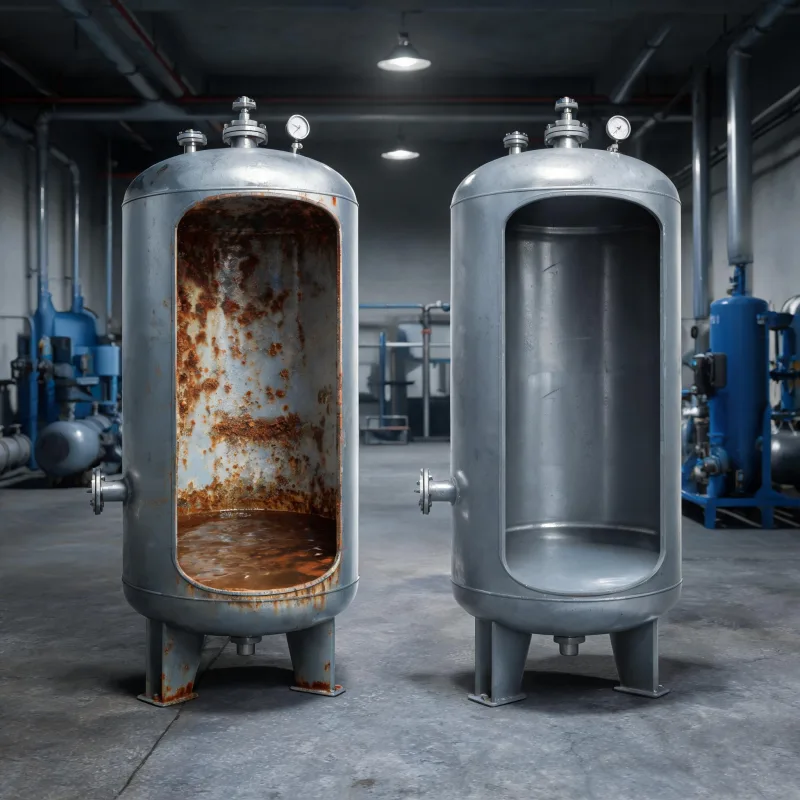
When air is compressed, all ambient moisture condenses into liquid. Most systems have primary moisture separators, but these don’t catch 100% of liquid moisture. The remaining moisture settles at the bottom of the receiver tank, creating standing water that eats through carbon steel over time.
Faulty or Underadjusted Drain Systems
Most new tanks come with factory-set auto drains that are calibrated for average humidity. Facilities in high-humidity climates or that run systems 24/7 need adjusted drain intervals to remove buildup faster. Manual drains are often forgotten by overstretched maintenance teams, leading to months of unaddressed standing water.
Proven Actionable Solutions
Adjust and Upgrade Drain Systems
Start with the lowest-cost, highest-impact fix: adjust your drain interval to match your facility’s operating conditions. For manual drains, schedule a weekly drain check. For high-humidity areas, add a daily 1-minute drain to your opening routine.
If you have an old mechanical auto drain, upgrade to a timed electronic drain. These cost less than $150 installed and eliminate human error from missed drains. Statista 2023 data shows that proper drain maintenance reduces overall system efficiency loss from moisture by 15% to 20% on average.
Remove Existing Rust and Apply Protective Coating
For tanks with minor surface rust and no structural damage, you can mechanically or chemically flush the tank to remove loose rust, then apply a food-grade or industrial-grade epoxy internal coating. This seals the tank walls and prevents further corrosion from contact with moisture.
This solution only works for tanks with less than 10% wall thickness loss. If you have between 10% and 20% loss, you’ll need more frequent annual inspections to monitor corrosion progression.
These flushing and coating solutions do not apply to tanks with more than 20% wall thickness loss from existing corrosion. Those tanks require immediate replacement per OSHA pressure vessel safety standards.
Upgrade Pre-Tank Moisture Separation
Add a high-efficiency cyclonic or refrigerated moisture separator upstream of your receiver tank. These systems remove up to 99% of condensed moisture before it enters the tank, cutting the amount of buildup that accumulates over time. This is a particularly effective upgrade for 24/7 high-flow industrial systems.
Schedule Annual Internal Inspections
Even with proper maintenance, schedule a full internal inspection and wall thickness test once per year. This catches early corrosion before it becomes a structural or safety issue. Most inspections cost between $200 and $400 for a standard industrial tank, far less than the cost of emergency replacement or shutdown.
Expert Insights
As a 12-year compressed air system maintenance specialist, addressing moisture buildup early is far more cost-effective than replacing a corroded tank later. Most issues stem from overlooked drain maintenance, which takes less than 5 minutes a week to correct for most small systems.
Further Reading
- Beginner’s Step-by-Step Guide to Maintaining Diesel Portable Air Compressor With Waste Heat Recovery
- How to Calculate Actual Power Consumption of Air Compressors
- Low Noise High CFM Diesel Portable Air Compressor for Urban Construction Worksites
- How to Fix Oil Carryover Phenomenon of Air Compressor Dryer Equipment
- How to Choose Suitable Air Compressor Dryers and Air Tanks
- Why Air Compressor Cannot Start Normally and Quick Repair Tips
- Diesel Portable Air Compressor Solutions for Off-Grid Construction Site Air Supply
- Why Air Compressor Tank Rusts and Effective Prevention Methods
About the Author

Frequently Asked Questions
How often should I drain my air receiver tank?
For most low-humidity facilities, drain once per week. High-humidity or 24/7 operations need daily manual checks or adjusted electronic drain intervals.
Can I remove existing rust from inside an air receiver tank?
Minor surface rust can be removed via flushing, followed by a protective internal coating. Extensive structural rust requires full tank replacement.
Does a moisture separator eliminate all water accumulation?
No, high-efficiency separators remove up to 99% of moisture, but trace amounts still accumulate over time, so regular drainage is still required.
How much does it cost to recoat an air receiver tank?
For a standard 200 to 500 gallon tank, professional recoating costs between $800 and $1,500, which is 75% less than full tank replacement.
Is internal corrosion in air receiver tanks a safety hazard?
Yes, unaddressed corrosion weakens tank walls and can lead to catastrophic rupture, which is why OSHA requires regular pressure vessel inspections.
Do aluminum air receiver tanks get rusty?
Aluminum does not rust, but it can still corrode from trapped acidic moisture over time, so the same drainage and inspection rules apply.
How long should an air receiver tank last with proper maintenance?
A properly maintained carbon steel air receiver tank lasts 15 to 20 years, matching its expected design lifespan.