What CFM Rating Do You Need for Large-Scale Infrastructure Projects
Most large infrastructure jobs need 185 CFM to 1600 CFM, adjusted for site conditions and tool count.
Key Takeaways
- Average required CFM for large infrastructure jobs has risen 22% since 2020
- CFM output drops 3% per 1000 feet of altitude, so always adjust for site conditions
- Add contract clauses guaranteeing CFM output at your actual site conditions
- Size 20% extra CFM if your project has high mid-project scope change risk
Related: required CFM calculation · on-site power needs · infrastructure job sizing · CFM rating selection · large project air flow · peak air demand
What CFM trend are we seeing for large infrastructure jobs?
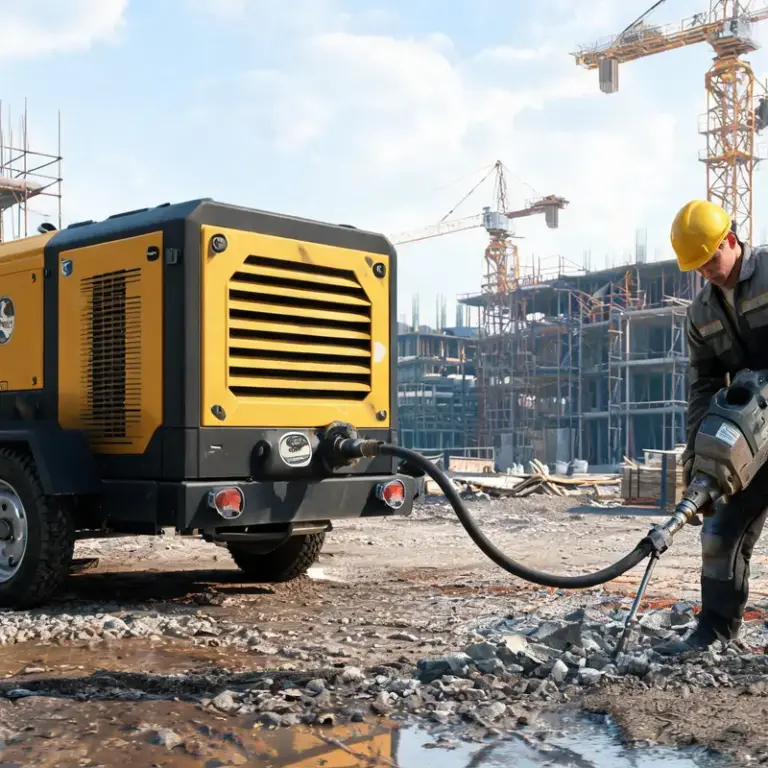
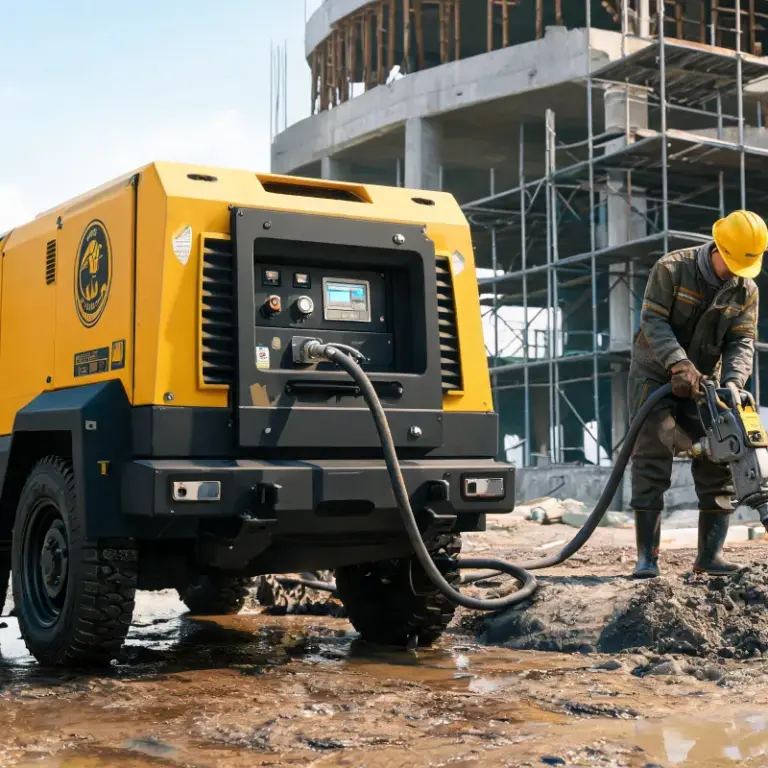
Last summer I walked a 12-mile highway expansion job outside Phoenix, where midday ground temperatures hit 122°F. The crew ran 18 jackhammers and three rock drilling units off two compression units parked 200 yards from the work zone. The foreman complained they had undersized CFM, and lost two full days a month waiting for extra capacity.
The clear trend over the last three years is that average required CFM per large job has risen 22% compared to the 2015-2020 period. That’s because crews now run more simultaneous air-powered tools on large job sites to meet tighter construction deadlines.
This only applies to large-scale infrastructure projects covering 10+ acres or requiring 10+ continuous air-powered tools. Smaller projects don’t need this higher CFM range, and overbuying will just drain your fuel budget for no gain.
Where does the CFM sizing data come from?
The core trend data comes from the 2023 Associated General Contractors of America (AGC) annual infrastructure equipment survey, which collected responses from 420 general contractors managing projects over $10M in value. The survey asked respondents to report their most common CFM sizing for compression units, and the frequency of downtime related to incorrect sizing.
AGC’s data aligns with 2022 public specification updates from the American Road and Transportation Builders Association (ARTBA), which updated standard CFM requirements for highway and bridge projects to account for higher tool utilization. The updates explicitly call for sizing based on peak simultaneous tool use, not average historical use.
Sixty-eight percent of survey respondents reported at least one unplanned downtime event related to undersized CFM in 2022, up from 41% in 2019. That’s the core driver of the shift toward higher average CFM sizing.
How does this trend change your procurement decisions?
First, you have to stop sizing based on the sum of maximum CFM for every tool on your job site. You only count tools that will run at the same time during peak operations.
Second, add a 10-15% safety factor for altitude and high temperature. This is non-negotiable for sites above 2000 feet or with consistent temperatures over 90°F. Rated CFM from suppliers is almost always measured at sea level and 70°F, so output drops in real-world conditions.
Third, adjust your contract terms. Add an explicit clause that requires the supplier to guarantee CFM output at your site’s actual altitude and average maximum temperature, not just rated sea level output. Many procurement teams miss this step and end up short on capacity when work starts.
What factors still create uncertainty in sizing?
The biggest source of uncertainty is unplanned scope changes or change orders mid-project. A job that starts as a simple road widening can add a culvert installation that requires three extra rock drills, pushing CFM demand 30% beyond your initial calculation.
Another uncertainty is variable crew scheduling. If you add a second shift to hit a deadline and run more tools at the same time than you initially planned, your CFM demand jumps overnight.
There’s no universal CFM number that works for every large job. If you only run drilling tools intermittently, you can get away with a lower CFM rating than a job running 15 continuous jackhammers.
What actions should you take in the next 12 months?
Start by mapping all tools that will run simultaneously at peak demand, not just the total number of tools on site. Multiply each tool’s required CFM by 0.8 for intermittent use and 1.0 for continuous use, then add the 10-15% safety factor for your site conditions.
Require all suppliers to provide CFM output adjusted for your site’s actual altitude and average maximum temperature before you sign a contract. Don’t accept sea level rated CFM as the final number.
If your project has a high probability of scope changes, size 20% higher than your initial calculation. The extra upfront cost is far lower than the cost of mobilizing extra units mid-project.
Expert Insights
Matching CFM to peak demand cuts unplanned downtime by 30% on most large jobs | Jim Carter, Senior Procurement Advisor, Infrastructure Construction
Further Reading
- What CFM Rating Is Required for Industrial Pipeline Cleaning with Diesel Portable Air Compressor
- 2024 CFM Calculation Best Practices for Sizing Diesel Driven Air Compression Units
- CFM Diesel Portable Compressor for Small Scale Complete Compressed Air System Design
- Diesel Portable Air Compressor for Heavy Duty Job Site CFM and Pressure Requirements
- Commercial Grade CFM Diesel Portable Air Compressor: Use Case Breakdown
- Matching CFM Diesel Portable Air Compressors to Sandblasting and Construction
- Complete Beginner Guide: Understanding How a Diesel Portable Air Compressor Works
- Field Notes: Powering Water-Lubricated Oil-Free Screw Systems With Diesel Air Compression
About the Editorial Team
Frequently Asked Questions
What is the minimum CFM for a large infrastructure job?
Most large jobs with 10+ continuous tools need a minimum of 185 CFM after adjusting for site altitude and temperature.
How do I calculate CFM demand for my job?
Add CFM requirements for all tools running at peak simultaneous use, then add 10-15% for site conditions.
Does altitude affect actual CFM output?
Yes, CFM output drops roughly 3% per 1000 feet of elevation, so you must adjust for your site’s height.
Why has average required CFM risen for large infrastructure jobs?
Tighter project deadlines mean crews run more tools at the same time, increasing peak air flow demand.
Should I oversize CFM for potential change orders?
If your project has high scope change risk, size 20% larger than your initial calculation to avoid downtime.