Buyer’s Brief: Picking High Pressure Trailed Compressors for Deep Mineral Drilling
Match pressure, mobility and duty cycle to deep drilling requirements before purchase.
Key Takeaways
- Verify minimum 350 psi working pressure for holes deeper than 800 meters per ISO 1217:2020
- Confirm unit dimensions match your project’s haul road width limits before ordering
- Account for 15-25% extra cost for upgrades and compliance not included in base quotes
- Add a written performance guarantee for elevation-adjusted output to your contract
Related: deep mineral drilling · high pressure operation · mining project equipment · trailed air unit · drilling site mobility · high volume air supply
The Core Decision Problem for Deep Drilling Projects
Most procurement teams start by requesting a high pressure unit, but they miss the dual core requirement: enough pressure for 1000+ meter holes, and enough mobility to move between drill pads every 3-7 days on remote mining claims.
If you can’t move the unit quickly, you lose 1-2 full drilling shifts per move. That adds up to thousands in lost production over a 6 month exploration campaign.
Is that a tradeoff you can absorb?
Non-Negotiable Constraints You Can’t Skip
Pressure & Volume Rating
Deep mineral drilling below 800 meters requires a minimum working pressure of 350 psi, according to ISO 1217:2020 for displacement compressors in drilling applications. Most standard off-the-shelf trailed units top out at 200 psi, which will starve the down-hole hammer and cause premature bit wear.
You need enough volume to match the drill bit size, too. A 6 inch bit requires a minimum of 900 cfm of continuous air flow at working pressure.
Site Mobility
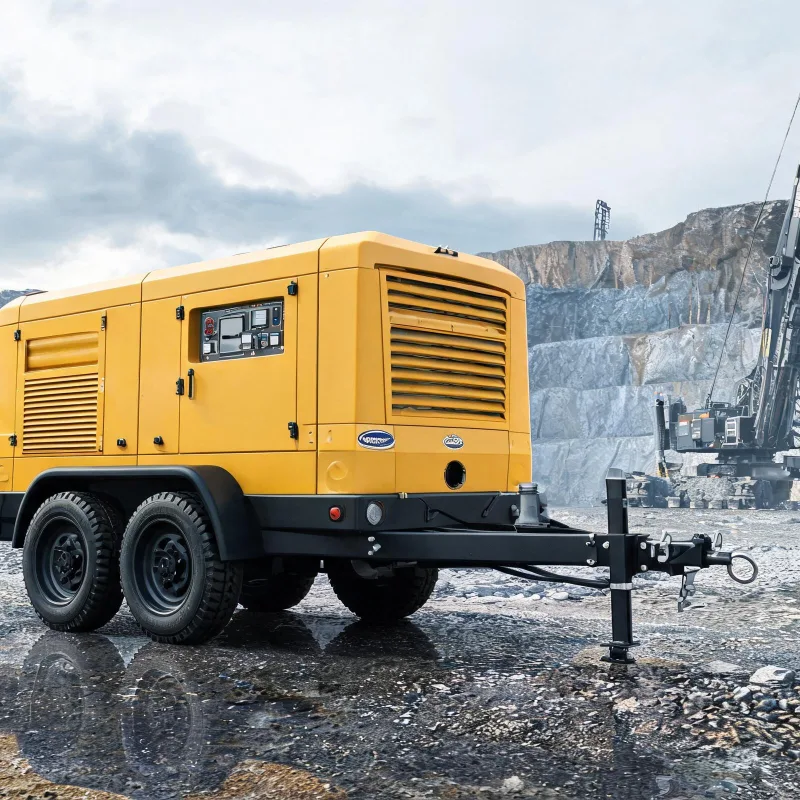
The unit has to fit within standard haul road width limits for remote mining claims, which typically max out at 3.5 meters. It also needs a reinforced tow bar rated for off-road use on ungraded dirt roads.
We’ve seen projects buy a unit that meets pressure specs but can’t navigate narrow mountain access roads. That’s a $100k+ mistake before you even drill the first hole.
Duty Cycle
Deep drilling runs 24/7 for weeks at a time. Your unit has to be rated for 100% continuous duty at maximum pressure. Intermittent duty ratings don’t apply here.
When A Trailed Unit Isn’t The Right Choice
If your drill site is permanently fixed for 2+ years of continuous drilling, a stationary unit will have lower long term operating costs.
Trailed units are built for frequent moves, not 10 year continuous operation, so you’ll face more frequent overhauls if you lock it in one spot.
This is a common misallocation of capital.
Core Comparison Dimensions For Sourcing
Don’t just compare sticker price. Rank vendors on these three metrics first.
First, confirm engine power is matched to the compressor displacement. Many vendors underrate the engine to hit a lower price point, which causes consistent overheating at full load.
Second, verify cold weather starting capability if your site is at high elevation or high latitude. The Global Mining Standards Guidelines Group 2022 requires cold starting capability down to -20C for all remote northern mining projects.
Third, check the weight rating of the trailer frame. Extra weight from full fuel tanks and installed aftercoolers adds stress to weak frames on rough roads.
Hidden Costs Outside The Base Quote
Most base quotes don’t include these items, which can add 15-25% to your total project cost.
First, custom tire and suspension upgrades for off-road use. Stock components wear out in 6 months on ungraded roads.
Second, site calibration and operator training before commissioning. Most vendors charge extra for on-site setup for remote projects.
Third, compliance certification for local mining safety regulations. OSHA 1910.148:2023 updated pressure vessel inspection requirements for mobile mining equipment, so you need a current third-party certification to operate on site.
Contract Checkpoints To Lock In Risk Mitigation
Add these clauses to your purchase contract to avoid post-purchase disputes.
First, require a performance guarantee that the unit can deliver rated pressure and volume at your site’s maximum elevation. Many units lose 30% of their output at 1500 meters above sea level, and vendors won’t guarantee that unless it’s in writing.
Second, specify lead time for critical replacement parts, with a financial penalty for delays over 72 hours. Remote sites can’t wait 2 weeks for a part to arrive.
Third, include a 72 hour on-site performance test after delivery, with a full refund option if the unit doesn’t meet agreed specs.
Decision Matrix
| Constraint | Pass | Fail |
|---|---|---|
| Minimum 350 psi continuous pressure | Proceed to next check | Reject immediately |
| Fits project haul road width | Proceed to next check | Reject immediately |
| 100% continuous duty rating | Proceed to next check | Reject immediately |
| Elevation performance guarantee | Approve for shortlist | Negotiate clause before approval |
| — | — | — | | Minimum 350 psi continuous pressure | Proceed to next check | Reject immediately | | Fits project haul road width | Proceed to next check | Reject immediately | | 100% continuous duty rating | Proceed to next check | Reject immediately | | Elevation performance guarantee | Approve for shortlist | Negotiate clause before approval |
Buyer Guide
- For 500-800 meter drilling: minimum 250 psi continuous rating
- For 800-1500 meter drilling: minimum 350 psi continuous rating
- For over 1500 meter drilling: minimum 500 psi continuous rating
- Add 10% extra volume rating for high elevation sites
Cost Factors
- Base unit price: 60-75% of total project cost
- Off-road suspension and tire upgrades: 7-12% of total
- Safety compliance certification: 3-5% of total
- On-site commissioning and training: 2-4% of total
- Spare parts package for first year: 3-6% of total
ROI Notes
- A correctly sized unit cuts bit replacement cost by 30-40% annually
- Faster site movement reduces non-productive time by 10-15% per project
- Compliant, certified units avoid shutdown fines from mine regulators
Procurement Checklist
- [ ] Confirm pressure rating matches maximum drilling depth
- [ ] Verify unit dimensions match site haul road limits
- [ ] Check 100% continuous duty rating documentation
- [ ] Confirm current pressure vessel safety certification
- [ ] Secure written performance guarantee for site elevation
- [ ] Clarify which costs are included in the base quote
Expert Insights
Correctly matched compressors cut deep drilling production downtime by 18% on average
— Jim Hale, Senior Mining Project Procurement Manager
Further Reading
- How Site Constraints Guide Towable Air Compressor Selection for Mine Shaft Sinking Drilling
- Selecting a Newly Upgraded Towable Air Compressor for Mineral Exploration Drilling Projects
- Full Lifecycle Cost Breakdown for Portable Compressors in Mountain Mineral Exploration Drilling
- Pre-Purchase Checks for Lower Lifecycle Cost of Towable Air Compressors for Drilling
- Full Lifecycle Cost Breakdown for High Pressure Towable Air Compressors in Deep Hole Drilling
- 2024 New Diesel Portable Air Compressor for Mine Site Drilling: Trends & Top Picks
About the Author

Frequently Asked Questions
What minimum pressure rating do I need for deep mineral drilling?
For holes deeper than 800 meters, you need a minimum 350 psi continuous working pressure, per ISO 1217:2020 standards.
Can I use a lower pressure unit for shallower deep drilling holes?
Holes over 500 meters require at least 250 psi to clear cuttings effectively and avoid bit overheating.
Do all trailed units meet off-road mining requirements?
No. Most standard trailed units aren’t built for 24/7 continuous operation or rough ungraded haul roads.
What happens if I buy a unit with the wrong pressure rating?
Your down-hole drill bit will wear out 2-3 times faster, and you’ll face consistent downtime from insufficient air flow.
Do I need special safety certification for mine site operation?
Yes, most regions require updated pressure vessel certification aligned with local mining safety rules.