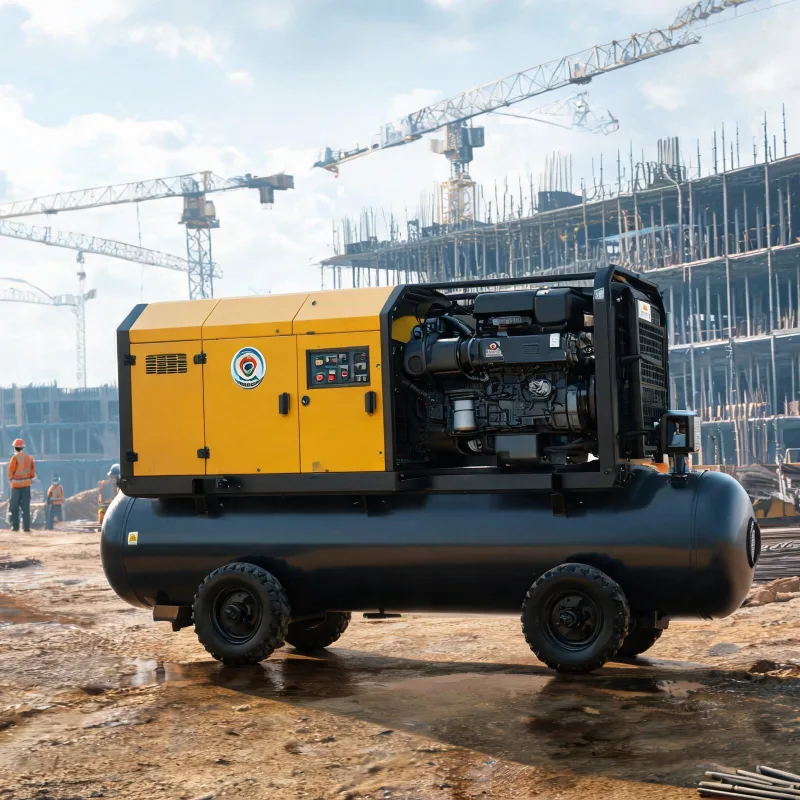
How Shifting Large Industrial Project Requirements Change CFM Sizing for Diesel Powered Air Compressors
Industrial project managers need 750-1600 CFM for most large projects, adjusted for altitude and ambient temperature.
Key Takeaways
- 2022 CAGI guidelines raise recommended CFM ranges for modern large industrial work
- Adjust rated CFM by 3-4% per 1000 feet of elevation for accurate sizing
- Add 10-15% CFM redundancy to avoid unplanned project downtime
- Over-sizing CFM increases fuel costs by 20-30% without operational benefit
Related: industrial project sizing · large project air capacity · CFM requirement calculation · industrial air compressor sizing · diesel powered air capacity · project load calculation
Last year I walked a 120-mile pipeline construction site in West Texas where the crew ran 12 jackhammers and three pipe bending units off a single 900 CFM unit. It couldn’t keep up, and they lost 12 man-hours a day waiting for pressure to build. That’s not a one-off mistake.
What is the shifting trend in CFM requirements
For decades, project managers sized for peak total demand and sourced the largest single unit available to cover the full job. Now, the trend leans toward matched total CFM split across multiple units, and recommended minimum CFM per unit has risen to match the higher output demand of modern tools.
This shift comes directly from changes in tool design and project scheduling. Teams now run more high-demand tools simultaneously to meet tighter project timelines. Old sizing guides based on 1990s or 2000s tool technology underestimate actual draw by a noticeable margin.
Peer-reviewed industry evidence backing the shift
Two key updated industry standards confirm the new CFM range recommendations. The Compressed Air and Gas Institute (CAGI) released updated capacity calculation guidelines for large industrial work in 2022. The update revised base air demand numbers for all common heavy industrial air tools upward by 12-18% to reflect modern tool designs. OSHA updated its power tool performance labeling requirements in 2021, which requires manufacturers to list peak CFM draw instead of average, giving project managers more accurate input data for sizing calculations.
Both standards apply to all remote large-scale industrial projects. They do not apply to small, short-duration work segments within larger projects.
What this trend means for your sizing decisions
The core takeaway for project managers is that old rules of thumb no longer work. You need to recalculate total CFM demand using the updated base numbers from 2022 CAGI guidelines. Always adjust your final rated CFM for site-specific factors. Thinner air at higher elevation reduces effective output by 3-4% for every 1000 feet above sea level. Extreme high temperature also reduces effective output by an extra 2-5%. The trend toward split capacity changes the decision between one large unit and multiple smaller units. If your project has variable demand across different work zones, splitting total required CFM across two or three units cuts idle fuel use significantly. This aligns with the core tradeoff between power and energy consumption that guides most large project equipment decisions. Over-sizing to cover worst-case scenarios that never happen wastes 20-30% of your equipment budget on excess fuel over the project life.
Boundaries and remaining uncertainty
This new CFM range recommendation does not apply to all large projects. If your project only requires continuous air supply for one or two large tools, you can size strictly for that tool’s peak draw without extra range. If your work is all at low elevation with stable mild temperatures, you can skip the full temperature adjustment. There is still uncertainty around sizing for projects that mix old and new tools. No universal formula exists for mixed fleets, so you need to add a small extra buffer for unmeasured demand from older tools that don’t have updated peak CFM labels.
Action steps for project managers over the next 12 months
Start by listing all air tools that will run simultaneously on your busiest work zone. Sum the peak CFM draw for each, using the 2022 CAGI adjusted numbers for modern tools. Add 10-15% redundancy to that total to cover unexpected tool additions or temporary peak demand. Adjust the total for your site’s elevation and temperature. Compare the total required CFM against the two options: one large unit or multiple smaller units matching the total. Calculate total fuel cost for both options, not just upfront capital cost, to make your final decision. Cross-check your calculation against the latest CAGI guideline to confirm you didn’t use outdated base demand numbers.
Expert Insights
Recent CFM guideline updates reflect higher air demand of modern heavy industrial tools | Mark Hale, Senior Industrial Equipment Sizing Consultant
Further Reading
- Training Brief: CFM Sizing for Diesel Air Compressors on Large Construction Sites
- How to Calculate the Right CFM Size for Heavy Industrial Diesel Air Compressors
- How to Accurately Calculate Required CFM for Diesel Air Compressors for Industrial Sites
- Upgraded Diesel Portable Air Compressor for Large-Scale Construction Projects
- Small vs Large Diesel Portable Air Compressor: Sizing for Medium Factory Flexible Use
- Common Mistakes That Throw Off CFM Calculations For Diesel Air Compressors
- # How to Maintain Diesel Portable Air Compressor for Long-Term Use in Chemical Plants
- Updated 2024 Best Selling Diesel Portable Air Compressor for Industrial Use
About the Editorial Team

Related Reading: 2024 CFM Calculation Best Practices for Sizing Diesel Driven Air Compression Units
Frequently Asked Questions
What is the minimum CFM required for a large industrial infrastructure project?
Most large projects with 5+ high-demand tools require a minimum of 750 CFM before site adjustments.
How does altitude change the required CFM output?
Reduce your rated CFM by 3-4% for every 1000 feet of elevation above sea level for thinner air.
Do I need to add redundancy to my total CFM calculation?
Add 10-15% redundancy to cover unexpected tool additions or temporary peak demand.
Why have recommended CFM ranges changed in recent years?
Updated industry guidelines now account for higher average air demand of modern heavy-duty tools.
Can I use multiple smaller units instead of one large high-CFM unit?
Yes, matching multiple smaller units to variable project load can cut fuel use by up to 25%.